


The flag folding ceremony at military funerals is a solemn way to honor veterans for their service. The American flag, draped over the casket or urn, is carefully folded into a triangle and presented to the family. This act symbolizes gratitude and respect, connecting the veteran’s sacrifice to the nation’s history.
Key Points:
- 13 Folds: Each fold symbolizes values like life, belief, and service, though these meanings are not officially recognized by law.
- Triangular Shape: Inspired by the tricorn hats of the Revolutionary War, it links the ceremony to America’s origins.
- Standardized Text: Since 2012, the Department of Defense requires a specific message when presenting the flag.
- Honor Guard Role: At least two members, including one from the veteran’s branch, perform the flag-folding ritual.
The folded flag, often displayed in a memorial case, becomes a cherished keepsake for families, preserving the memory of the veteran’s service.
History of the Flag Folding Ceremony
Folding the American flag into a triangle is a practice thought to have started in the late 18th and early 19th centuries, as the flag became a powerful national symbol. The triangular shape is said to resemble the tricorn hats worn during the Revolutionary War, further tying the tradition to the fight for American independence.
The tradition of draping flags over caskets took hold during the American Civil War, when honoring fallen soldiers became more structured. By World War II, as military funerals became more frequent, the flag's symbolic role grew even stronger. Over time, this led to the development of formal guidelines by military and patriotic organizations.
Although the U.S. Flag Code, established in 1942, outlines proper flag care, it does not specify an official folding method. Instead, the folding procedure was gradually standardized by groups like the American Legion and VFW. Eventually, the Department of Defense formalized the process in Instruction 1300.15, requiring the folding and presentation of the flag during military funeral honors.
The meanings often attributed to the 13 folds of the flag are not officially recognized by Congress or federal law. One of the earliest scripts explaining the "13 folds" is credited to an unnamed chaplain from the U.S. Air Force Academy. However, in July 2006, the Air Force introduced a new script for flag-folding ceremonies. This updated version emphasizes historical facts rather than religious interpretations. Lt. Col. Samuel Hudspath, the Air Force protocol chief, clarified:
"Our intent was to move away from ascribing meaning to the folds and instead focus on the flag's role in U.S. Air Force history".
This shift reflects a broader evolution in the ceremony, aligning it with other traditions that honor the flag's role as a symbol of sacrifice.
The flag-folding ceremony also shares similarities with the "ceremony of retreat", performed daily by the U.S. Armed Forces when the flag is lowered at night to honor the nation's fallen.
sbb-itb-4fbc981
How to Fold a Flag: The Official Procedure
13-Fold Military Flag Folding Ceremony Step-by-Step Guide
Preparing the Flag and Ceremony Setup
At a military funeral, the flag is carefully draped over the casket, with the blue field (canton) positioned at the head, over the deceased's left shoulder. This placement is rich in tradition, symbolizing respect and gratitude for the veteran's service. The honor guard then folds the flag in complete silence, adding to the solemnity of the occasion.
The 13 Folds and What They Represent
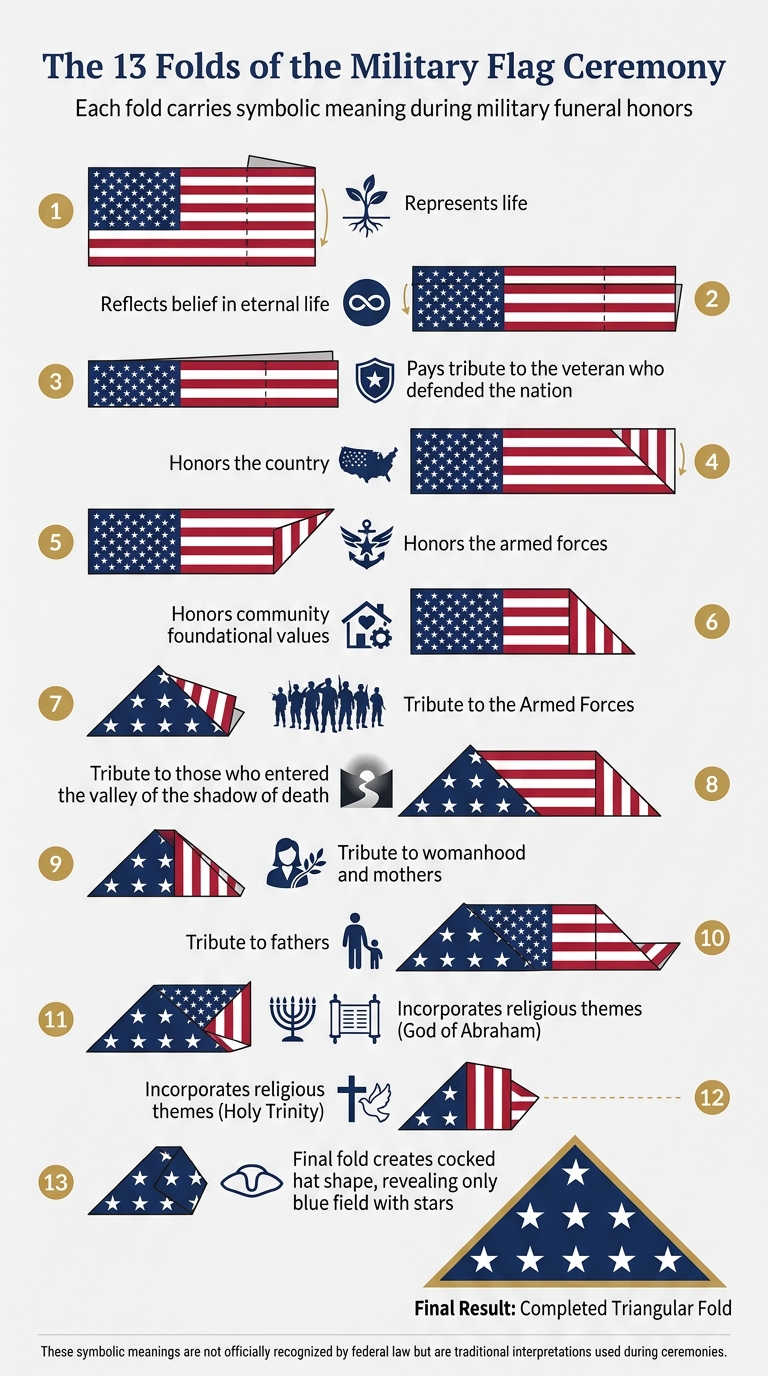
Once the flag is properly positioned, the honor guard begins the meticulous process of folding it into 13 sections. While not officially codified, each fold is said to carry symbolic meaning. For example:
- The first fold represents life.
- The second reflects belief in eternal life.
- The third pays tribute to the veteran who defended the nation.
Subsequent folds honor the country, the armed forces, and the community's foundational values. The 11th and 12th folds incorporate religious themes, recognizing the God of Abraham and the Holy Trinity. By the time the 13th fold is complete, the flag is shaped like a cocked hat, with only the blue field and stars visible. This final form serves as a reminder of the national motto, "In God We Trust".
Families may choose to have the meanings of the folds recited during the ceremony. William F. Tuerk, VA Undersecretary for Memorial Affairs, once remarked:
"Honoring the burial wishes of veterans is one of the highest commitments for the men and women of VA. A family may request the recitation of words to accompany the meaningful presentation of the American flag as we honor the dedication and sacrifice of their loved ones."
Presenting the Folded Flag to the Family
After the folding ritual is complete, the flag is presented to the family with the utmost respect. This moment follows the playing of Taps and serves as a heartfelt acknowledgment of the veteran's service. The Department of Defense standardized the presentation text on April 17, 2012. The words express gratitude on behalf of the President of the United States and a grateful nation, recognizing the veteran's honorable and faithful service. This final act bridges the public recognition of their service with the family's personal loss.
The Honor Guard's Responsibilities
The honor guard carries out a deeply respectful role during a veteran's funeral. Federal law requires that an honor guard detail includes at least two members of the Armed Forces, with one representing the veteran's branch of service. Military funerals are overseen by the United States Army Military District of Washington (MDW), while official protocols are set by the Department of Defense through DoD Instruction 1300.15. These guidelines align seamlessly with other ceremonial traditions, such as flag folding.
During the ceremony, the honor guard carefully lifts the flag from the casket, holding it taut and squared for folding. In formal settings, six honor guards - three on each side of the casket - perform the 13-fold flag folding with meticulous attention to protocol.
After the flag is folded, a member of the honor guard from the deceased's branch of service presents it to the next of kin. This presentation follows strict guidelines, with the folded flag handed over so the straight edge faces the recipient. Since April 17, 2012, the Department of Defense has required the presenter to recite the following:
"On behalf of the President of the United States, the United States (Army, Marine Corps, Navy, Air Force, Space Force or Coast Guard), and a grateful nation, please accept this flag as a symbol of our appreciation for your loved one's honorable and faithful service."
The flag folding is timed to either coincide with or follow the playing of Taps. When active-duty personnel are unavailable, Reserve and National Guard units take on these responsibilities. Families must provide the veteran's DD Form 214 to funeral directors to confirm eligibility for an honor guard detail.
Whether the ceremony involves a burial or cremation, the honor guard demonstrates the same level of precision and respect, even when presenting the flag alongside an urn. This unwavering attention to detail embodies the enduring respect and traditions of military service.
Preserving the Folded Flag with Memorial Cases
After the solemn flag-folding ceremony, ensuring the proper care of the folded flag helps preserve its significance. Once the honor guard presents the flag to the family, it becomes a cherished keepsake, symbolizing both national recognition and personal remembrance. The burial flag, measuring 5 feet by 9.5 feet, is larger than standard flags and is folded into a precise triangle, revealing only the blue field of stars.
"The burial flag is intended as a keepsake for the family and should be treated with the same respect accorded to any American flag." - Tina Wilhelm, Life Remembered
To protect the flag, a memorial case is essential. These cases create a controlled environment that shields the flag from dust, humidity, and UV light - factors that can weaken its fabric, fade its colors, and cause permanent creases. With the U.S. cremation rate projected to reach 61.8% in 2024, more families are choosing to preserve and display their loved one’s flag at home, extending the ceremonial honor into their personal space.
A memorial case does more than protect; it ensures the flag remains a lasting tribute. It prevents misuse and provides a dedicated area to honor the veteran's memory. Shadow box-style cases take this a step further, allowing families to display medals, patches, or other memorabilia alongside the flag.
How to Choose a Memorial Flag Case
When selecting a memorial flag case, there are a few key factors to keep in mind to ensure both protection and presentation.
Start with size compatibility. Burial flags require cases specifically designed for their 5' x 9.5' dimensions. Using a case meant for standard decorative flags can lead to improper fit, which may damage the fabric or leave it unsecured.
Next, opt for hardwood construction - materials like walnut, oak, or cherry provide durability and a classic finish. Since the case will likely be on display for years, choosing a wood tone that complements your home décor creates a cohesive tribute.
UV-protective glass is another must-have feature. If the case will be placed in a room with natural light, this glass prevents harmful rays from fading the flag or weakening its fibers. Museum-grade glass offers the highest level of protection for flags displayed near windows or in bright spaces.
"UV-protective glass isn't an upgrade - it's a necessity if the case will be displayed in any room with natural light." - Bags of Flags
Look for cases with ample depth and sturdy backing to support the flag's shape without applying too much pressure. High-quality hardware, such as brass or stainless steel hinges, ensures the case stays securely closed. Additionally, gaskets or tight seals help block dust and airborne particles. For long-term preservation, the interior lining should be made from acid-free, archival-quality materials to avoid yellowing or chemical damage.
Finally, consider placement. Wall-mounted cases keep the flag at eye level for a prominent display, while shelf-mounted options create a dedicated memorial area. Avoid placing the case near direct sunlight or heat sources to maintain the flag’s condition.
Action Flag Memorial Products

Action Flag offers a range of memorial flag cases specifically designed for preserving burial flags. These cases are built to accommodate the standard 5' x 9.5' military burial flag and feature durable hardwood frames. Options include traditional triangular cases for the flag alone or larger shadow boxes that allow families to display medals, patches, and photos alongside the flag.
Each case is crafted with preservation in mind, incorporating secure hardware and proper depth to maintain the flag’s shape. For a personal touch, Action Flag also offers custom engraving, allowing families to include service details, dates, or meaningful inscriptions. Proudly made in the USA, these cases meet the high standard of respect befitting a veteran’s tribute.
Whether you’re looking for a simple display case or a more elaborate shadow box, Action Flag provides options that honor your loved one’s service while ensuring the flag remains a treasured symbol for generations to come.
Conclusion
The flag folding ceremony is much more than a routine ritual; it's a profound gesture of respect and remembrance. This time-honored tradition at military funerals carries immense meaning, transforming a national emblem into a deeply personal keepsake for grieving families. Each of the 13 folds not only reflects precision but also conveys heartfelt symbolism, turning a public act into a treasured memory.
What makes this ceremony even more poignant is its inclusivity - it honors all eligible veterans, no matter the burial method. For cremation services, the honor guard holds the flag over the urn before performing the ceremonial folds, ensuring every veteran is given the respect they deserve. This meticulous attention to detail underscores the commitment to honoring their service.
The triangular shape of the folded flag calls to mind the tricorn hats worn by Revolutionary War soldiers, symbolizing the enduring connection between past and present. It also serves as a powerful reminder of the responsibilities and privileges of citizenship, and the lasting gratitude owed to those who served.
"The folded flag presented to family becomes a bridge between the public and the private. Publicly, it's a symbol from the nation. Privately, it's an object you will carry into a home that no longer feels the same." - Funeral.com
From the solemn rifle volleys to the haunting notes of Taps, the ceremony builds to a moment of stillness, where history and honor converge. When the folded flag is finally handed to a family member, a public tribute transforms into a deeply personal remembrance. This act ensures that the sacrifices made by veterans are not only acknowledged but carried forward, preserving their legacy for future generations.
FAQs
Who is eligible to receive military funeral honors and a burial flag?
Military funeral honors and a burial flag can be provided to the next of kin or a close family member of a veteran or reservist who meets one of the following criteria:
- Served during wartime
- Died on active duty after May 27, 1941
- Served after January 31, 1955
- Served in peacetime before June 27, 1950
- Served in the Selected Reserves under specific conditions
Can families request or decline the 13-fold meanings being read aloud?
Families have the option to request that the 13-fold meanings not be read aloud during the ceremony. The official protocols focus on maintaining the solemnity of the event and the dignified presentation of the flag. Ultimately, whether these meanings are included or omitted often depends on the honor guard or funeral director, who take the family's preferences into account.
How should a folded burial flag be stored to prevent fading or damage?
To keep a folded burial flag in excellent condition, store it in a protective case. Place it in a spot away from direct sunlight, moisture, and extreme temperatures. This careful storage ensures the flag remains preserved and respected for years.

