


Yellow and gold don’t have one meaning across national flags. In this guide to 13 countries, I compare what these colors represent, where they appear, and how history shapes their use. To read a flag, <u>check its official description first</u> - then separate the color’s meaning from the star, cross, sun, or other symbol it fills.
My comparison covers wealth and resources, political unity, sovereignty, faith, and colors with no fixed official meaning. Design matters, too: Colombia’s yellow band fills 50% of its flag, while South Africa’s yellow is a narrow border.
Quick Comparison
| Country | Yellow or gold appears as | Meaning or context |
|---|---|---|
| Colombia | Top half of the flag | Resources, wealth, sovereignty, and justice |
| Ecuador | Top half, behind a coat of arms | Abundance, fertile land, the sun, and prosperity |
| Venezuela | Top band | Wealth, the sun, and prosperity |
| Ghana | Middle band | Mineral wealth |
| South Africa | Border beside the black triangle | No official color meaning; the overall design expresses unity |
| Jamaica | Diagonal cross | Sunshine, wealth, prosperity, and resources |
| China | Five stars | Party leadership and the people’s unity |
| Kazakhstan | Sun and eagle | Meanings belong to the emblems, not gold alone |
| Brazil | Central diamond | Gold reserves and prosperity; roots in the imperial flag |
| Germany | Bottom band, officially called gold | Freedom movements and democratic history |
| Sweden | Nordic cross | Heraldic gold and Christian roots |
| Spain | Broad center band | National color without one fixed meaning |
| Vatican City | Yellow field and gold key | Sovereignty and papal authority |
I’ll use each flag’s design and history to explain these differences - not assume that yellow always means wealth.
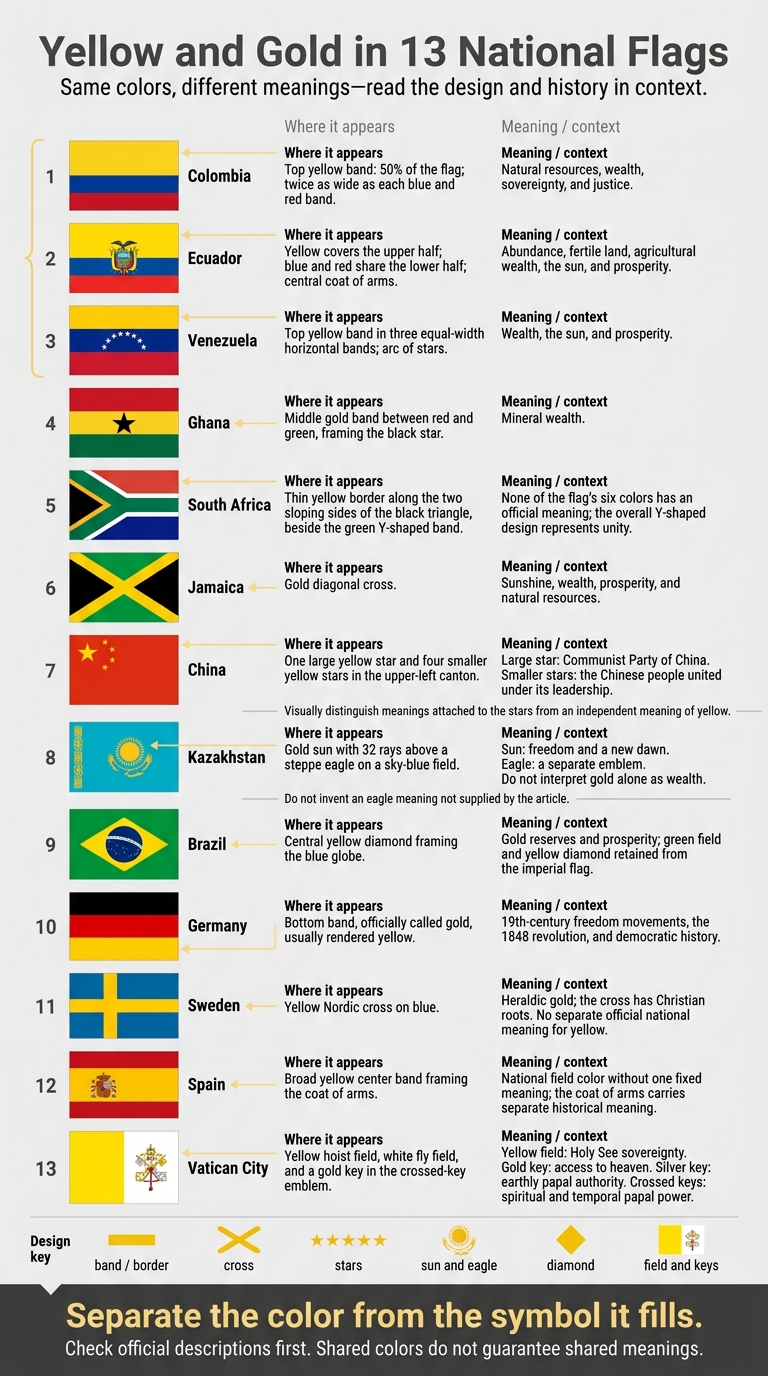
Yellow and Gold in 13 National Flags
1. Colombia
Colombia’s flag gives a shared regional tricolor its own national meaning.
Symbolism
The yellow band represents Colombia’s natural resources, wealth, sovereignty, and justice.
Design
Yellow fills the upper half of the flag, making it twice as wide as each blue and red band.
The proportions and symbols help tell these flags apart: Ecuador adds a coat of arms, while Venezuela uses equal-width bands with an arc of stars. Colombia’s proportions trace back to a shared revolutionary design.
Historical Context
The colors come from Francisco de Miranda’s yellow-blue-red tricolor, created as a symbol of independence from Spain. Gran Colombia, the republic that existed from 1819 to 1831, used these colors. Colombia, Ecuador, and Venezuela kept them in their flags, creating a tricolor family in which each flag carries its own national meaning.
2. Ecuador
Meaning
Ecuador’s yellow stands for abundance, fertile land, agricultural wealth, the sun, and prosperity.
Design
Yellow covers the flag’s upper half, while blue and red share the lower half. The coat of arms sits in the center and features Mount Chimborazo, linking the design to Ecuador’s landscape and sovereignty.
Historical Context
Ecuador retains the Gran Colombia tricolor and adds a coat of arms to give the flag its own national identity. Venezuela uses the same color family but changes the layout again.
3. Venezuela
Meaning
Yellow represents wealth, the sun, and prosperity. Blue stands for the sky and Caribbean Sea, as well as justice and loyalty. Red honors patriots’ blood, bravery, and sacrifice.
Design
Venezuela’s flag has three equal-width horizontal bands: yellow, blue, and red. An arc of stars represents the provinces that first declared independence. The stars’ number and arrangement have changed over time.
Historical Context
Venezuela keeps the same color family, but its equal bands and star arc set it apart. In the flags that follow, these same colors carry different meanings.
4. Ghana
Meaning
Ghana’s gold represents mineral wealth.
Visual Role
The gold band sits between the red and green stripes, framing the black star.
Historical Context
Ghana’s red, gold, and green reflect its independence-era identity and Pan-African ideals. South Africa’s flag uses this shared color language in a different way.
5. South Africa
Documented Symbolism
Unlike Ghana’s gold, South Africa’s yellow serves as a design accent rather than a symbolic color. The Y-shaped design represents unity, showing different parts of South African society coming together and moving forward together. None of the flag’s six colors has an official meaning.
Visual Role
Yellow forms a thin border along the two sloping sides of the black triangle at the hoist - the side nearest the flagpole. This border separates the triangle from the green Y-shaped band, keeping the shapes distinct.
Historical Context
South Africa adopted the flag on April 27, 1994, during its first multiracial democratic elections.
6. Jamaica
Documented Symbolism
Jamaica’s gold represents the sun, wealth, prosperity, and natural resources. It’s more than decoration: gold carries a national meaning rooted in the country’s independence-era identity.
Like Ghana, Jamaica connects gold with prosperity, but frames that connection through independence.
Visual Role
Gold forms the flag’s diagonal cross, making it the design’s focal point.
Historical Context
Jamaica adopted its flag on August 6, 1962, when the country gained independence.
7. China
On China’s flag, yellow represents political authority rather than wealth.
Documented Symbolism
China’s Five-Star Red Flag features one large yellow star for the Communist Party of China and four smaller stars for the Chinese people united under its leadership. The red field represents the communist revolution.
Visual Role
The stars sit in the upper-left corner, known as the canton. The four smaller stars form an arc around the large star, with each pointing toward its center. This arrangement reinforces unity under Party leadership.
Historical Context
Adopted on October 1, 1949, the flag marked the founding of the People’s Republic of China and the start of a new political era. In this context, the yellow stars represent political authority, not wealth.
8. Kazakhstan
Documented Symbolism
Unlike China’s stars, Kazakhstan uses gold in a natural emblem rather than a political one. Its flag shows a gold sun with 32 rays above a steppe eagle on a sky-blue field. The sun represents freedom and a new dawn, while the eagle stands as a separate emblem. Gold should not be read as a symbol of wealth here.
Visual Role
Read the sun and eagle separately. Their shared gold color does not give them a single shared meaning.
sbb-itb-4fbc981
9. Brazil
Brazil uses gold as a central emblem, rather than a stripe.
Documented Symbolism
The flag’s yellow diamond is linked to Brazil’s gold reserves and prosperity.
Visual Role
The yellow diamond contrasts with the green field. It also frames the blue globe and the motto Ordem e Progresso (Order and Progress) at the flag’s center.
Historical Context
Brazil adopted its current flag on November 19, 1889. It kept the green field and yellow diamond from the imperial flag but replaced the central coat of arms with a blue globe depicting the night sky over Rio de Janeiro and the motto Ordem e Progresso.
10. Germany
Germany differs from the earlier examples: gold is the official color name, not just a symbolic interpretation of yellow.
Documented Symbolism
Germany officially calls its third color gold, a term defined in law and heraldry. Black, red, and gold became national colors through their ties to the early 19th-century freedom movement and the 1848 revolution. They differ from the imperial black-white-red.
Visual Role
Gold forms the bottom stripe of Germany’s horizontal tricolor. It usually appears as yellow, but the official description remains gold. Its meaning comes from Germany’s political history, not decoration.
Historical Context
The colors continued into the Weimar Republic and remain linked to Germany’s freedom movement. Together, black, red, and gold represent continuity in the country’s democracy and history.
11. Sweden
Documented Symbolism
The yellow cross on Sweden’s flag comes from heraldic gold, not a separate official national meaning.
Visual Role
The yellow cross creates a sharp contrast against the blue background.
Historical Context
The cross has long served as a Christian symbol. Sweden’s flag follows the Nordic cross tradition.
Spain uses yellow differently: instead of forming a cross, it serves as a dominant background color.
12. Spain
Spain puts yellow at the center of its flag, using it as a broad field of color rather than a cross, star, or emblem.
Documented Symbolism
The yellow band and coat of arms are separate symbols. Yellow serves mainly as a national field color, without a single fixed meaning. The coat of arms carries its own historical meaning.
Visual Role
The wide yellow center creates the flag’s strongest contrast and frames the coat of arms.
Historical Context
Red and yellow are enduring national colors for Spain, while the coat of arms provides the clearest historical reference. Yellow serves as both color and structure - a role reflected in the design patterns that follow.
13. Vatican City
Documented Symbolism
Vatican City uses yellow and gold as symbols of authority - not decoration or wealth. The yellow field signals Holy See sovereignty. The gold key represents access to heaven, while the silver key represents earthly papal authority. Crossed together, the keys express the papacy’s spiritual and temporal power.
Visual Role
The flag divides that meaning between its two-color field and central emblem. Yellow fills the hoist side, nearest the flagpole, and white fills the fly side. These colors form the state flag, while the crossed keys and tiara identify papal authority.
Historical Context
The crossed keys have symbolized the papacy since the 14th century. Vatican City is a sovereign state, while the Holy See is a separate sovereign authority.
Flag Design: Bands, Crosses, Stars, and Emblems
Look at the shape first. Color alone doesn’t determine meaning: yellow or gold can form a band, cross, star, diamond, or border.
| Country | Design cue |
|---|---|
| Colombia | The top yellow band covers 50% of the field. |
| Ecuador | A top yellow band with a central coat of arms. |
| Venezuela | Three equal bands, with stars marking the provinces. |
| South Africa | Yellow borders the black triangle beside the green Y-shaped band. |
| China | One large yellow star and four smaller stars sit in the upper-left canton. |
| Brazil | A yellow diamond sits in the center. |
| Vatican City | A vertical gold-and-white bicolor with crossed keys. |
Context matters, too. South Africa’s convergence symbolism comes from the flag as a whole - not yellow alone. History helps explain why each country uses these shapes differently.
Flag History: Shared Colors, Different Meanings
In heraldry, gold (Or) is classified as a metal and has long been linked to the sun.
Shared origins help explain why flags use the same colors. But those colors don’t always carry the same meaning. Colombia, Ecuador, and Venezuela all trace their flags to Francisco de Miranda’s Gran Colombia tricolor, yet each country gives the colors its own meaning.
Germany’s flag has a different history: its black-red-gold tricolor reflects 19th-century liberal and republican movements.
Conclusion: Read Each Flag in Context
The same colors can mean different things across flags. Yellow and gold may represent wealth, authority, the sun, or faith - but their meaning depends on context.
Separate the color from the symbol it fills.
A yellow band may express wealth, while a gold star, sun, or cross can carry a distinct political or religious meaning.
Shape matters just as much as color. To interpret a flag, start with official records rather than popular explanations. Then check where the color appears: in a field, a band, or a star, sun, cross, or emblem.
Read those details alongside the country’s history and flag customs. Don’t assume a color’s meaning on one flag applies to another.
FAQs
How can I verify a flag color’s official meaning?
Start with the statutes or legislative records that govern the flag’s adoption. These documents often describe the design and its intended symbolism, including the colors and what they mean.
Check those details against local historical sources or official government archives to confirm the interpretation. General databases and symbolism analyzers can add context, but don’t treat them as the final authority.
Does gold on a flag require metallic fabric?
Gold on a flag does not require metallic fabric. The color often represents wealth, prosperity, and enlightenment. It’s usually shown on standard flag fabrics such as nylon, polyester, or rayon.
Formal or ceremonial flags, including indoor and parade flags, may feature gold-colored threads or bullion fringe. But the flag itself is made from durable textiles, not actual metal.
Can a flag’s color meanings change over time?
Yes, a flag’s color meanings can change as values, politics, and a society’s hopes shift. During the Civil War, different factions rallied behind specific patterns of the Maryland state flag. The combined design later became a symbol of reconciliation and unity. These meanings reflect a flag’s history, but they can shift as a society’s identity or priorities change.

