


The U.S. Flag Code provides guidelines on how to display and care for the American flag, but its enforcement varies. For civilians, compliance is entirely optional - there are no penalties for violations. However, federal agencies and the military must strictly follow specific flag protocols, backed by enforceable regulations. Some states and municipalities impose penalties for flag misuse, with fines or even imprisonment in certain cases. Here's a breakdown:
- Civilians: Voluntary adherence; no legal consequences.
- Federal Agencies: Strict rules under Executive Orders and federal law.
- Military: Detailed protocols enforced under military discipline.
- State/Local Laws: Vary widely; some impose fines or jail time for violations.
While no federal agency enforces the Flag Code for civilians, education and voluntary correction are emphasized. Local organizations, like the American Legion, often provide guidance on flag etiquette. Legal action is rare and usually tied to state or local laws rather than the Flag Code itself.
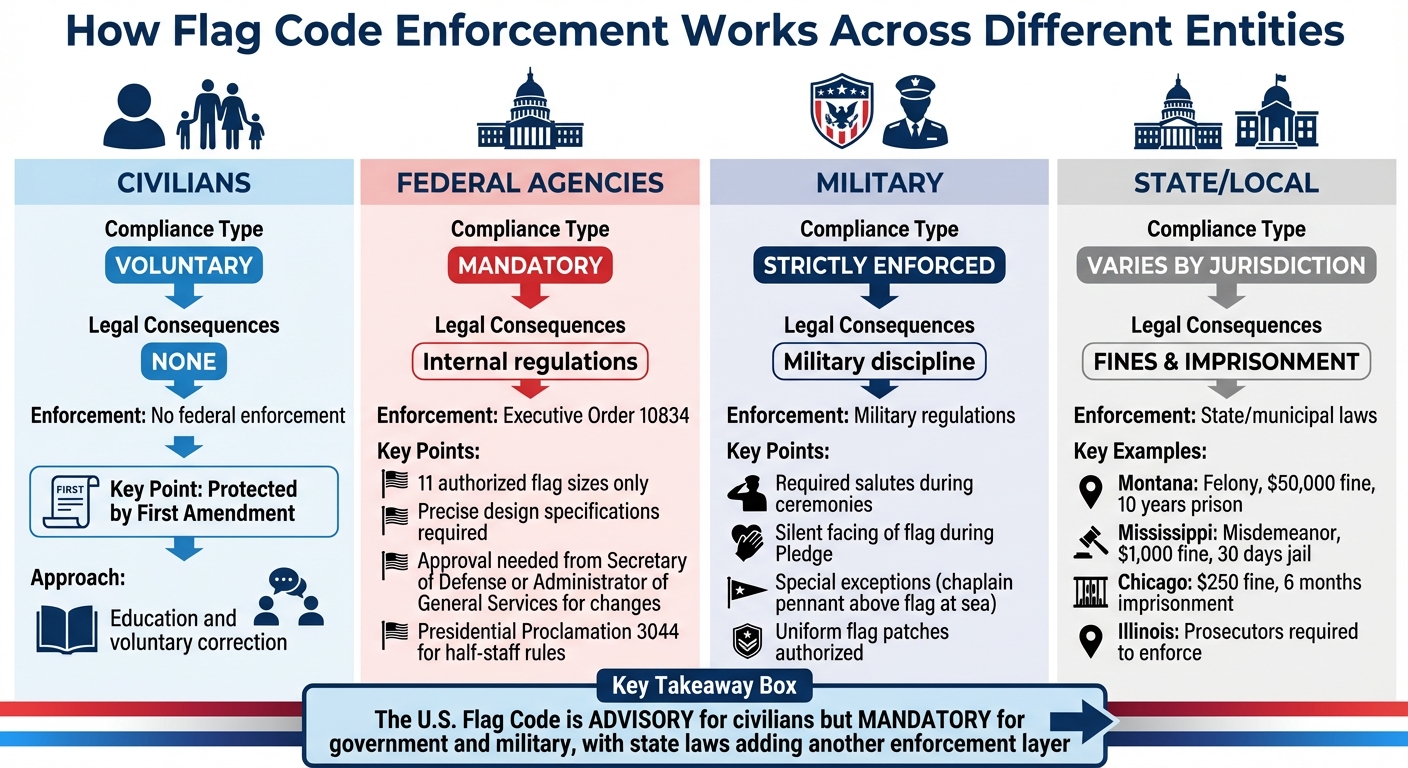
U.S. Flag Code Enforcement by Entity: Civilians vs Federal vs Military vs State/Local
The Flag Code Is Advisory, Not Mandatory
The Flag Code as a Set of Guidelines
The U.S. Flag Code outlines traditions and customs surrounding the American flag, but it’s not legally binding. Its language leans on terms like "should" and "custom" rather than directives such as "must" or "shall." For example, it suggests that the flag "should be hoisted briskly", without mandating a specific method. The Congressional Research Service explains:
"relevant case law would suggest that the provisions without enforcement mechanisms are declaratory and advisory only".
This means that while the Code provides guidance, it doesn’t impose legal obligations on civilians.
Voluntary Compliance for Civilians
For civilians, following the Flag Code is entirely optional. There are no federal penalties, fines, or legal consequences for not adhering to its recommendations. The Congressional Research Service clarifies:
"The Flag Code does not prescribe any penalties for non-compliance nor does it include enforcement provisions; rather the Code functions simply as a guide to be voluntarily followed by civilians and civilian groups."
A notable example occurred in July 2019, when the Republican National Committee incorrectly folded a flag sent to U.S. Representative Seth Moulton. Instead of the traditional triangular fold with stars outward, the flag was folded differently. Despite this, no legal action was taken, as the Flag Code’s guidelines are advisory.
Unlike federal agencies and military personnel, who must adhere to specific flag protocols, civilians are not held to the same standard. Most Americans follow the Flag Code out of respect and a sense of patriotism rather than because of any legal requirement. For federal agencies and the military, however, compliance is mandatory.
sbb-itb-4fbc981
Flag Compliance Requirements for Government and Military
Executive Orders for Federal Agencies
Federal agencies must adhere to strict guidelines when it comes to displaying the U.S. flag. Executive Order 10834 lays out the precise design, proportions, and sizes required for flags used by executive agencies, which include executive departments, independent establishments, and government-owned corporations. These rules are mandatory and leave no room for deviation.
The law also draws a clear line between civilian and government flag usage. As stated in 4 USC §5:
"The following codification of existing rules and customs pertaining to the display and use of the flag of the United States of America is established for the use of such civilians or civilian groups or organizations as may not be required to conform with regulations promulgated by one or more executive departments of the Government of the United States."
For federal agencies, only 11 specific flag sizes are authorized. These flags range in hoist measurements from 1.32 to 20.00 feet, with the fly being exactly 1.9 times the hoist. Any changes to these dimensions require approval from the Secretary of Defense or the Administrator of General Services. The Secretary of Defense oversees flag procurement for the Department of Defense, while the Administrator of General Services handles procurement for other federal agencies.
Agencies must also comply with Presidential Proclamation 3044, which sets consistent rules for flying the flag at half-staff. For instance, the flag must be flown at half-staff for 30 days after the death of a President or former President, and for 10 days following the death of a Vice President, Chief Justice, or Speaker of the House.
While these regulations are strict, military flag protocols go even further in their requirements.
Military Flag Protocols
Military personnel operate under even more detailed and strictly enforced flag protocols. For example, during ceremonies like the Pledge of Allegiance or the raising and lowering of the flag, service members are required to remain silent, face the flag, and salute. These are not merely customs but enforced regulations under military discipline.
The military also has specific exceptions to standard flag rules. According to 4 USC §7(c), naval chaplains conducting services at sea are permitted to fly the church pennant above the U.S. flag - this is the only situation where another flag can take a higher position. Additionally, military, fire, and police personnel are allowed to wear flag patches on their uniforms. While this would typically conflict with the Flag Code’s guidelines against using the flag as apparel, these exceptions are explicitly authorized.
State and Local Flag Enforcement
Municipal Flag Display Ordinances
In some cities, like Chicago, strict rules govern the handling and display of flags. For instance, it's illegal to place the U.S. or city flag on the ground. Violators can face fines of up to $250 and even six months of imprisonment per offense. The term "flag" is interpreted broadly, covering any representation that clearly appears to be the official flag. Many municipalities also restrict the use of flags in commercial settings. Businesses are prohibited from adding marks, words, or designs to flag depictions intended for display.
State Flag Laws and Penalties
State laws add another layer of enforcement when it comes to flag violations, with penalties that vary widely depending on the jurisdiction. For example, in Montana, desecrating a flag is classified as a felony, carrying a hefty fine of up to $50,000 and a possible prison sentence of 10 years. By contrast, Mississippi treats similar violations as misdemeanors, with penalties capped at a $1,000 fine and 30 days in jail.
| State | Legal Classification | Maximum Fine | Maximum Imprisonment |
|---|---|---|---|
| Montana | Felony | $50,000 | 10 years |
| Illinois | Class 4 Felony (mutilation) / Class C Misdemeanor (advertising) | Not specified | Not specified |
| Oklahoma | Class D3 Felony | Not specified | Not specified |
| Texas | Class A Misdemeanor | Not specified | Not specified |
| Connecticut | Class A Misdemeanor | Not specified | Not specified |
| Mississippi | Misdemeanor | $1,000 | 30 days |
Illinois takes a unique approach to flag law enforcement. State's Attorneys are required to prosecute violations within their counties, and law enforcement must report suspected breaches. To encourage compliance, the state offers a financial incentive: half of any penalty recovered in a case goes to the person who filed the complaint, with the other half allocated to the county school fund. However, prosecutions must be initiated within six months of the offense.
In Georgia, flag protection is tied to monument preservation. If someone damages or destroys a flag that is part of a publicly owned monument, they may be required to pay three times the cost of repair or replacement, along with attorney's fees and court costs.
These examples highlight the varied and layered approaches that states and municipalities take to enforce flag protocol and ensure compliance with their laws.
How Flag Code Violations Are Handled
Reporting a Flag Code Violation
When it comes to handling Flag Code violations, the process depends on the situation. Interestingly, there’s no federal agency tasked with enforcing the Flag Code. Instead, violations are reported to the appropriate government body or organization.
For flags displayed at government buildings or military installations, reports should be directed to the specific executive department or military branch overseeing that facility. These entities often have their own internal regulations governing flag use. For civilian cases, organizations like the American Legion often step in. They provide guidance on proper flag display and disposal practices.
Once a violation is reported, the focus is usually on educating the individual or group about proper flag etiquette rather than imposing penalties.
Education and Voluntary Correction
Since the Flag Code operates on a voluntary basis, the emphasis is on education rather than enforcement. The goal is to inform and encourage proper flag handling. If you notice a flag being mishandled, reaching out to a local American Legion post is a good first step. They can clarify proper flag etiquette and help address the situation.
Educational efforts often include addressing common misconceptions. For example, many people wrongly believe that a flag touching the ground must be destroyed. In reality, the Flag Code allows flags to be washed or dry-cleaned if necessary. Public events, such as flag retirement ceremonies held on Flag Day (June 14), are also used to teach proper disposal methods and reinforce respectful practices.
While education is the primary approach, there are rare instances where legal action might come into play.
When Legal Action May Occur
Legal action for Flag Code violations is uncommon, largely because of First Amendment protections. Most provisions of the Flag Code are considered "declaratory and advisory only" for private citizens, meaning they lack enforceable penalties.
However, there is an exception in the District of Columbia, where 4 U.S.C. § 3 outlines criminal penalties for using the flag in advertisements or for mutilating it. Violations can result in fines of up to $100, imprisonment for up to 30 days, or both. Even so, these provisions often face constitutional challenges under Supreme Court rulings.
Legal action is more likely in commercial contexts, such as using the flag to promote products or services. The Supreme Court has yet to fully decide whether these specific prohibitions violate free speech rights under the First Amendment.
Conclusion
The U.S. Flag Code serves as a guide for Americans to honor and respect the nation's most iconic symbol. It outlines the proper ways to display and care for the flag, highlighting its role as a powerful emblem of national unity. This distinction also helps explain the differences in enforcement between civilian and official settings.
For civilians, following the Flag Code is entirely voluntary, protected under First Amendment rights. Choosing to adhere to it often reflects a personal sense of patriotism and respect. On the other hand, government agencies and military branches are required to follow strict flag protocols, as their compliance is governed by enforceable regulations.
Education, rather than punishment, is the cornerstone of the Flag Code’s approach. By following its guidelines, individuals and organizations alike demonstrate respect for the flag, fostering a sense of unity through shared traditions. Whether displayed at home, in businesses, or on government properties, treating the flag with dignity helps preserve its meaning and honors the values it represents.
FAQs
Who actually enforces flag rules in the U.S.?
The rules governing the U.S. flag are outlined in federal law under the Flag Code. However, these guidelines are largely advisory and don't carry legal penalties for violations. Instead, adherence to the Flag Code is typically driven by social customs and personal accountability, rather than being enforced by government authorities.
Can I be fined or arrested for misusing the U.S. flag?
Yes, under federal law, there are penalties such as fines or imprisonment for misusing or damaging the U.S. flag. This includes acts like mutilating the flag or using it for advertisements, as specified in the U.S. Flag Code and related legal statutes.
What should I do if I see a flag being displayed improperly?
If you see a flag being displayed incorrectly, the U.S. Flag Code can provide helpful guidance on proper and respectful handling. While the Flag Code isn't legally enforceable, it strongly discourages actions like defacement, mutilation, or any form of disrespect toward the flag. If you encounter a violation, you can notify local authorities or relevant organizations. Alternatively, you can take action yourself by replacing the flag or disposing of it correctly, following the proper procedures outlined in the code.

