


Military flag precedence ensures proper respect and order when displaying flags at events or ceremonies. This guide outlines the official hierarchy based on the founding dates of U.S. military branches and key protocols for flag arrangements.
Key Takeaways:
- U.S. National Flag always comes first in any display.
-
Military branch flags follow in this order during peacetime:
- U.S. Army (June 14, 1775)
- U.S. Marine Corps (Nov 10, 1775)
- U.S. Navy (Oct 13, 1775)
- U.S. Air Force (Sept 18, 1947)
- U.S. Space Force (Dec 20, 2019)
- U.S. Coast Guard (Aug 4, 1790, unless in wartime, where it moves to 4th).
- State flags are displayed after the U.S. flag but before military flags.
- POW/MIA flag is placed after all military flags unless exceptions apply.
Display Rules:
- Flags must be evenly spaced and flown at the same height, with the U.S. flag higher if central.
- Vertical displays must place the U.S. flag’s union (blue field) in the top left.
- Adjustments are needed during wartime, where the Coast Guard flag moves up in precedence.
By following these guidelines, you can ensure proper protocol and respect for military traditions.
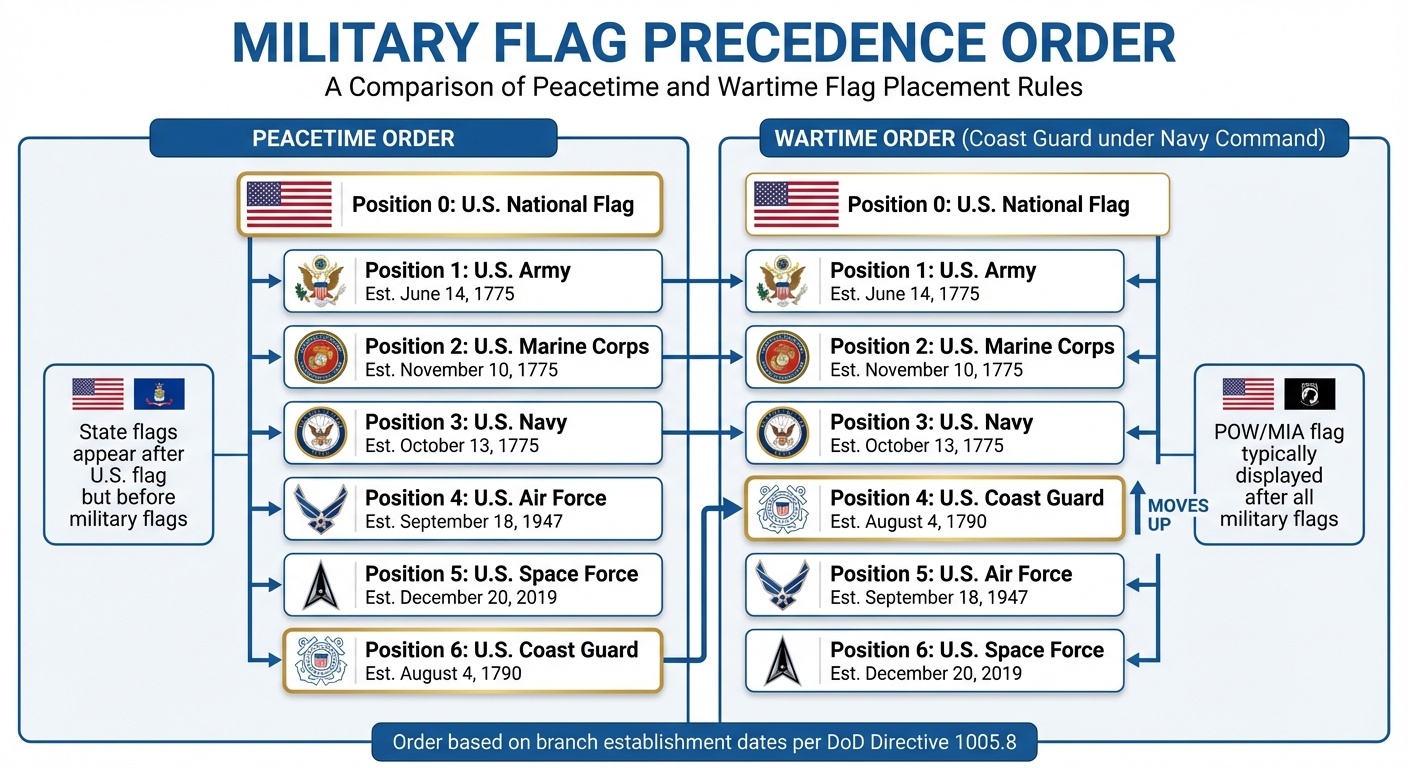
U.S. Military Flag Precedence Order: Peacetime vs Wartime Display
The Official Order of Military Flags
1. U.S. National Flag
The U.S. National Flag always holds the top spot in any flag arrangement. According to Department of Defense Directive 1005.8, it takes precedence over all military service flags.
"The American flag holds a position of utmost importance in flag displays. It represents the U.S. Government, which is the highest authority in the nation." – AmericanFlags.com
When displayed in a row, the U.S. flag should be positioned at the far left (its own right) and must be equal to or larger than any other flag in the arrangement.
Following the National Flag, military service flags are arranged based on the founding dates of their respective branches.
2. Military Service Flags in Order of Precedence
After the U.S. and state flags, military service flags are displayed in a specific order tied to their branch's establishment date. This order, known as the peacetime order, is as follows:
- U.S. Army – June 14, 1775
- U.S. Marine Corps – November 10, 1775
- U.S. Navy – October 13, 1775
- U.S. Air Force – September 18, 1947
- U.S. Space Force – December 20, 2019
- U.S. Coast Guard – August 4, 1790
The Coast Guard typically ranks last during peacetime since it operates under the Department of Homeland Security. However, in wartime, when it transfers to the Department of the Navy, its flag moves up to fourth position - following the Navy and preceding the Air Force.
| Service Branch | Establishment Date | Peacetime Position | Wartime Position |
|---|---|---|---|
| U.S. Army | June 14, 1775 | 1st | 1st |
| U.S. Marine Corps | November 10, 1775 | 2nd | 2nd |
| U.S. Navy | October 13, 1775 | 3rd | 3rd |
| U.S. Air Force | September 18, 1947 | 4th | 5th |
| U.S. Space Force | December 20, 2019 | 5th | 6th |
| U.S. Coast Guard | August 4, 1790 | 6th | 4th |
3. Additional Flags (State, POW/MIA, Others)
State flags are displayed after the National Flag but before military service flags, following the order in which states joined the Union. The Merchant Marine flag, while not representing an official military branch, is often placed immediately after the Coast Guard flag.
The POW/MIA flag is typically displayed after all military service flags. However, in certain cases - such as when no state flags are present - it may be positioned directly after the U.S. National Flag.
For military flags that meet official display standards, check out Action Flag's collection of service flags, POW/MIA flags, and display accessories at Action Flag.
Key Considerations for Display Environments
When arranging flags, it’s essential to account for the environment and context to ensure proper display. Here’s a closer look at the key factors to keep in mind.
1. Peacetime vs. Wartime Displays
The positioning of the Coast Guard flag depends on whether the United States is in peacetime or wartime, as outlined in the Department of Defense Directive No. 1005.8:
"During any period when the United States Coast Guard shall operate as part of the United States Navy, the... United States Coast Guard... shall take precedence, respectively, next after the... United States Navy." - Department of Defense Directive No. 1005.8
Before setting up a flag display, verify the Coast Guard's operational status. This ensures the flag order reflects the correct precedence for the current conditions.
From there, the arrangement can vary depending on whether the display involves a single branch or multiple branches of the military.
2. Single-Branch vs. Mixed-Service Displays
In single-branch displays, such as those at a Coast Guard base, only the U.S. National Flag and the branch’s service flag are displayed. These flags should be spaced evenly and flown at the same height.
For mixed-service displays, like those at joint-service bases or national ceremonies, the Department of Defense Directive 1005.8 provides clear guidance. The U.S. National Flag always comes first, followed by the service flags in their proper order of precedence, arranged from the viewer's left to right.
The type of display - whether indoors or outdoors - also plays a role in flag placement.
3. Indoor vs. Outdoor Arrangements
Outdoor displays with equal-height flagpoles require the U.S. flag to be placed on the viewer’s left. If the setup includes a taller central pole, the U.S. flag should be flown at the highest point.
Indoor displays, such as those used in ceremonies or color guard presentations, follow the same left-to-right precedence. Flags are typically mounted on floor stands or carried by members of the color guard. Regardless of the setting, it’s crucial to determine the audience's primary viewing direction, as this dictates the proper flag sequence.
Proper Flag Positioning and Spacing
Once the flag order is determined, positioning and spacing become the next key steps to ensure a respectful and visually balanced display. Aligning flags with precision and maintaining consistent spacing not only honors the flags but also enhances the overall presentation. These details are essential for achieving a proper military flag display.
1. Viewer Perspective and Orientation
Flag arrangements are always designed with the viewer's perspective in mind. The U.S. National Flag, as the flag of highest honor, should be placed on the far left from the audience's viewpoint. This rule applies whether the flags are displayed in a straight line, mounted on a podium, or carried in a procession. For podium displays, the U.S. flag is positioned on the speaker's right (which is the audience's left), while all other flags are placed to the speaker's left.
2. Equal Height and Symmetry
When multiple flags are displayed on separate poles of the same height, they should all be flown at equal height to create a balanced and uniform look. However, no flag should ever be flown higher than or be larger than the U.S. flag. If the setup includes a taller central pole, the U.S. flag must occupy the highest position. For displays featuring flags of equal sovereignty, such as multiple national flags, all flags should be of similar size and flown from poles of the same height to reflect equality.
3. Vertical and Horizontal Displays
For vertical displays, the orientation of the union (blue field) is crucial. When the U.S. flag is hung vertically against a wall, the union must be in the upper left corner from the observer's perspective. The same rule applies to horizontal wall displays. In semicircular arrangements, place the U.S. flag at the center of the arc, with military service flags arranged on either side in their correct order of precedence.
sbb-itb-4fbc981
Special Circumstances and Exceptions
While standard flag precedence typically follows a well-defined hierarchy, there are unique situations where adjustments are necessary. Knowing these exceptions helps maintain proper protocol, even in less common or extraordinary circumstances. These changes ensure that military decorum remains intact.
1. Wartime Adjustments
One of the most notable exceptions to flag precedence involves the United States Coast Guard during wartime. Normally, the Coast Guard operates under the Department of Homeland Security, placing its flag last among the military branches. However, during wartime, it transitions to the Department of Defense and comes under the command of the U.S. Navy.
This change in command shifts the Coast Guard flag’s position to fourth in precedence, directly after the U.S. Navy and before the U.S. Air Force. As outlined in Department of Defense Directive No. 1005.8:
"Provided, however, that during any period when the United States Coast Guard shall operate as part of the United States Navy, the Cadets, United States Coast Guard Academy, the United States Coast Guard, and the Coast Guard Reserve, shall take precedence, respectively, next after the Midshipmen, United States Naval Academy, the United States Navy, and the Naval Reserve."
Before arranging any display, it’s essential to verify whether the Coast Guard is currently operating under Navy command.
| Position | Peacetime Display | Wartime Display (Under Navy Command) |
|---|---|---|
| 1 | U.S. Army | U.S. Army |
| 2 | U.S. Marine Corps | U.S. Marine Corps |
| 3 | U.S. Navy | U.S. Navy |
| 4 | U.S. Air Force | U.S. Coast Guard |
| 5 | U.S. Space Force | U.S. Air Force |
| 6 | U.S. Coast Guard | U.S. Space Force |
2. POW/MIA and Veterans Flags
The POW/MIA flag is a symbol of profound importance and must be displayed with care. When flown on the same pole as the U.S. flag, it should be placed immediately below the national flag. If displayed on a separate pole, ensure it is flown either at or below the U.S. flag’s height; if positioned at the same level, it should be to the left of the U.S. flag.
When displayed in a row of flags, the POW/MIA flag is often treated as the first organizational flag in precedence - following state flags but preceding military service flags. However, some guidelines suggest placing it after all military branch flags. The U.S. Flag Code provides recommendations, though these are not legally binding.
The POW/MIA flag is traditionally displayed on Armed Forces Day, Memorial Day, Flag Day, Independence Day, National POW-MIA Recognition Day, and Veterans Day. Additionally, the Retiree flag may be flown beneath the U.S. flag on occasions such as Veterans Day or during ceremonies honoring retirees.
Following these standards ensures a respectful and consistent display.
3. Reserve and National Guard Flags
Flags for Reserve and National Guard components are arranged according to the order established in DoD Directive 1005.8. These flags are displayed immediately after the active-duty service flags. Within each branch, the National Guard flag takes precedence over the Reserve flag. For example, the Army National Guard is placed before the Army Reserve.
The overall sequence mirrors the seniority of the parent branches: Army, Marine Corps, Navy, Air Force, and Coast Guard. After the active-duty flags (Army, Marine Corps, Navy, Air Force, Space Force, Coast Guard), the order is as follows:
- Army National Guard
- Army Reserve
- Marine Corps Reserve
- Naval Reserve
- Air National Guard
- Air Force Reserve
- Coast Guard Reserve
If the Coast Guard operates under Navy command during wartime, the Coast Guard Reserve flag moves up to follow the Naval Reserve flag.
For events involving all components, maintaining this order ensures each service is properly recognized. For precise flag arrangements at formal ceremonies, organizations like Action Flag (https://actionflag.com) provide military and service flags tailored to specific needs.
Military Flag Precedence Checklist
Use this checklist to ensure your flag display follows proper protocol. Each step helps maintain the respect and order required for military flag presentations.
1. Verify the Correct Flag Order
Start by confirming that the U.S. National Flag holds the place of highest honor. Arrange the military service flags in this specific order: Army, Marine Corps, Navy, Air Force, Space Force, and Coast Guard. Note that during wartime, if the Coast Guard operates under Navy command, it moves to the fourth position.
If you're including state or POW/MIA flags, place them immediately after the U.S. flag. Make sure their placement does not interfere with the sequence of the military service flags.
2. Check for Proper Placement and Spacing
Ensure all flags in a row are evenly spaced and flown at the same height, except when the U.S. flag is centered and elevated. For crossed staff displays, the U.S. flag should be on the observer's left, raised first, and lowered last.
For vertical wall displays, the union (the blue field with stars) must always be at the top and to the observer's left. In processions, position the U.S. flag on the marching right or centered.
3. Inspect Flags for Condition and Orientation
Examine each flag for signs of wear like fraying, holes, fading, or dirt. As Nick Lydon from Gettysburg Flag Works emphasizes:
"All flags should be in good condition - retire old flags and replace faded, torn, or tattered flags immediately".
A damaged flag shows disrespect, so replace it promptly if needed.
Finally, check that all flags are correctly oriented. For vertical displays, the U.S. flag's union must always be in the upper left. If displayed at night, ensure it is properly illuminated.
Conclusion
With this checklist, you’re equipped to ensure proper flag displays every time. Following the official flag order not only shows respect for the nation but also honors the history and seniority of its service branches. The Department of Defense established this protocol through DoD Directive 1005.8 to maintain a consistent standard across all displays.
As U.S. Navy Veteran Travis R. explains:
"The order of precedence for military flags is determined by the Department of Defense and necessary to follow when displaying colors."
By adhering to these guidelines, you can confidently arrange flags in any setting. Double-checking the flag order, placement, and condition ensures the U.S. National Flag is always given its rightful prominence, with service flags displayed in their proper sequence.
Avoiding mistakes like arranging flags based on branch size or visibility instead of seniority is crucial. This preparation also keeps you ready for changes, such as adjustments during wartime.
Whether you’re organizing a display for a government building, a veterans’ event, or a business, following these standards reflects respect for military traditions and values. Action Flag helps you uphold these principles, ensuring your displays remain both respectful and compliant.
FAQs
What counts as “wartime” for Coast Guard flag precedence?
When the Coast Guard operates under the Department of the Navy, it is considered “wartime” for flag precedence. During these times, the Coast Guard's position in the order of precedence shifts, placing it immediately after the Navy.
How do I order flags if I’m using only one flagpole?
When displaying the U.S. flag on a single flagpole, it should always occupy the highest position as a mark of honor. If multiple flags are being flown, they should be arranged beneath the U.S. flag in a specific order: state flags come first, followed by military service flags in this sequence - Army, Marine Corps, Navy, Air Force, and Coast Guard. Always ensure that the flag displayed aligns with the occasion and adheres to established etiquette.
Where do Reserve and National Guard flags go in the lineup?
Flags representing the Reserve and National Guard are typically displayed following the active-duty service flags in the established order of military precedence: Army, Marine Corps, Navy, Air Force, Space Force, and Coast Guard. Depending on the specific guidelines being followed, these flags may also be placed in auxiliary or organizational roles.

