


Before buying a flagpole, I’d get written confirmation of where it can go - and which approvals it needs. Flag-display rights don’t automatically clear an installation, especially near dunes, bluffs, or flood zones.
I review 5 coastal states - not a verified ranking of the strictest rules:
- Florida: HOA protections, local zoning, and coastal permits.
- California: Flag-display protections, local coastal review, and height limits.
- North Carolina: Town rules, erosion setbacks, and site-plan approval.
- New Jersey: Accessory-structure rules, coastal review, and easements.
- Virginia: Shoreline buffers, floodplain rules, zoning, and private restrictions.
The supplied sources verify no numeric height limits or setbacks for these five states. My advice: <u>confirm the current rules for your exact lot</u>, check easements and HOA terms, and get approval before buying equipment or digging.
Compare Coastal Flagpole Placement Rules
The table shows what the supplied sources verify - and where you’ll need to check local rules.
| State | Verified placement rule | What still needs local confirmation |
|---|---|---|
| Florida | Not verified in supplied sources | Local ordinance needed |
| California | Not verified in supplied sources | Local ordinance needed |
| North Carolina | Not verified in supplied sources | Local ordinance needed |
| New Jersey | Not verified in supplied sources | Local ordinance needed |
| Virginia | Not verified in supplied sources | Local ordinance needed |
The supplied material does not verify numeric height limits, setback requirements, or permit triggers for these states.
Before choosing a pole, ask the planning office for the exact flagpole ordinance, your zoning district, and any overlay district. Confirm how setbacks are measured, whether you need a permit, the ordinance number, and the date of confirmation.
sbb-itb-4fbc981
Find the Rules for Your Coastal Property
Before choosing a shoreline location, separate flag-display rights from installation approval. Governor’s directives and half-staff notices address display. State flag-display protections do not govern shoreline placement; coastal management, zoning, building, and floodplain rules do. Contact each office before choosing the foundation location. Ask whether wind exposure, foundation excavation, dune disturbance, bluff erosion, or bluff instability affects approval.
Check recorded easements and HOA covenants separately. Ask the HOA for the written restriction, its adoption date, and the installation area. Flag-display protections may limit an association’s authority, but they do not automatically remove valid safety requirements or other property restrictions.
A permit exemption does not waive other requirements. Zoning, coastal, building, floodplain, and private restrictions may still apply.
Before relying on a requirement, confirm the current statute, administrative rule, or local ordinance and its effective date as of October 11, 2026. Use flag-status pages and executive-order alerts only to check display directives - not placement rules.
1. Florida
In Florida, HOA limits, coastal review, and local zoning can all affect the same flagpole site. Near the mean high water line, coastal review and coordination for state permits may apply.
Florida law protects residential flagpoles in HOAs, though HOA height limits may still apply. That protection does not override local placement rules.
The next states show similar overlaps between shoreline rules and local placement limits.
2. California
California relies on local coastal review rather than a verified statewide setback rule. The supplied sources confirm neither a statewide bluff-setback rule nor a statewide coastal permit process for flagpoles.
Coastal Setbacks and Erosion Rules
Before choosing a flagpole site on an erosion-prone bluff or shoreline parcel, check the local coastal rules.
Flagpole Height and Zoning Limits
California Civil Code sections 4705 and 4710 protect U.S. flag and noncommercial flag displays. But those protections don’t guarantee approval of every pole height or location. Check local height, setback, and zoning limits, including whether the flagpole falls under a signage classification.
Permit and Coastal Review Requirements
Permission to display a flag isn’t the same as approval to install a flagpole near the coast. Confirm which agency reviews the installation and whether it requires a permit or qualifies for an exemption.
Easements and Local Placement Rules
Section 4705 protects American-flag displays on separate property or exclusive-use common areas, subject to public-health and safety limits. The site must still meet local placement rules, so check those before installing the pole.
North Carolina has a similar overlap between coastal rules and local placement limits.
3. North Carolina
Coastal Setbacks and Erosion Rules
If your oceanfront or soundfront lot is prone to erosion, check whether local erosion setbacks or dune-protection rules affect where you can place a flagpole. North Carolina coastal towns can regulate flagpoles, and placement rules differ by town. Reviewing your specific site matters more than relying on a statewide rule.
Flagpole Height and Zoning Limits
Ask your town’s planning staff how your zoning district’s ordinance treats freestanding and building-mounted poles. Check any height limits and rules for how the town classifies each type.
Permit and Site-Plan Review
Confirm whether you need town approval and whether your site plan meets setback and placement standards. Include the pole’s location, height, and mounting method.
New Jersey follows a similar town-by-town approval process.
4. New Jersey
New Jersey follows the same town-by-town approach, but coastal overlays add another layer of review.
Coastal Setbacks and Erosion Rules
In Avalon, Chapter 27 classifies freestanding flagpoles as accessory structures, showing how New Jersey coastal lots can face both zoning and shoreline limits.
Before choosing a foundation site, check restrictions tied to dunes, beaches, bulkheads, and wetlands.
Flagpole Height and Zoning Limits
Freestanding flagpoles count as accessory structures, so height and setback limits apply. Building-mounted poles require a separate classification.
Permit and Coastal Review Requirements
Contact Avalon’s zoning and construction offices to confirm which approvals your installation needs. Local zoning approval does not satisfy floodplain or NJDEP coastal review requirements.
Easements and Local Placement Rules
Before digging, review the survey and recorded easements. Pay close attention to beach-access routes, utility corridors, and bulkhead-maintenance access. These placement constraints often matter more than pole height alone.
5. Virginia
Virginia’s shoreline, floodplain, and zoning rules all affect flagpole placement. You’ll need to check both coastal requirements and local site approval.
Coastal Setbacks and Erosion Rules
Find out which Chesapeake Bay, Atlantic shoreline, or tidal-water ordinance applies to your lot. Then check your planned foundation location against shoreline buffers, erosion setbacks, and floodplain rules.
Flagpole Height and Zoning Limits
Confirm how the local ordinance classifies a freestanding flagpole. That classification will help you check the applicable height limits and accessory-structure setbacks.
Permit and Coastal Review Requirements
Give the permitting office your planned pole height and foundation location. Ask whether the project needs zoning, building, floodplain, or coastal review.
Easements and Local Placement Rules
The Freedom to Display the American Flag Act of 2005 limits HOA and condominium restrictions on U.S. flag display on a member’s property. Ask your association to identify any placement restriction and explain its safety basis. Also check the proposed site against recorded easements and public rights-of-way.
Coastal Flagpole Installation Checklist
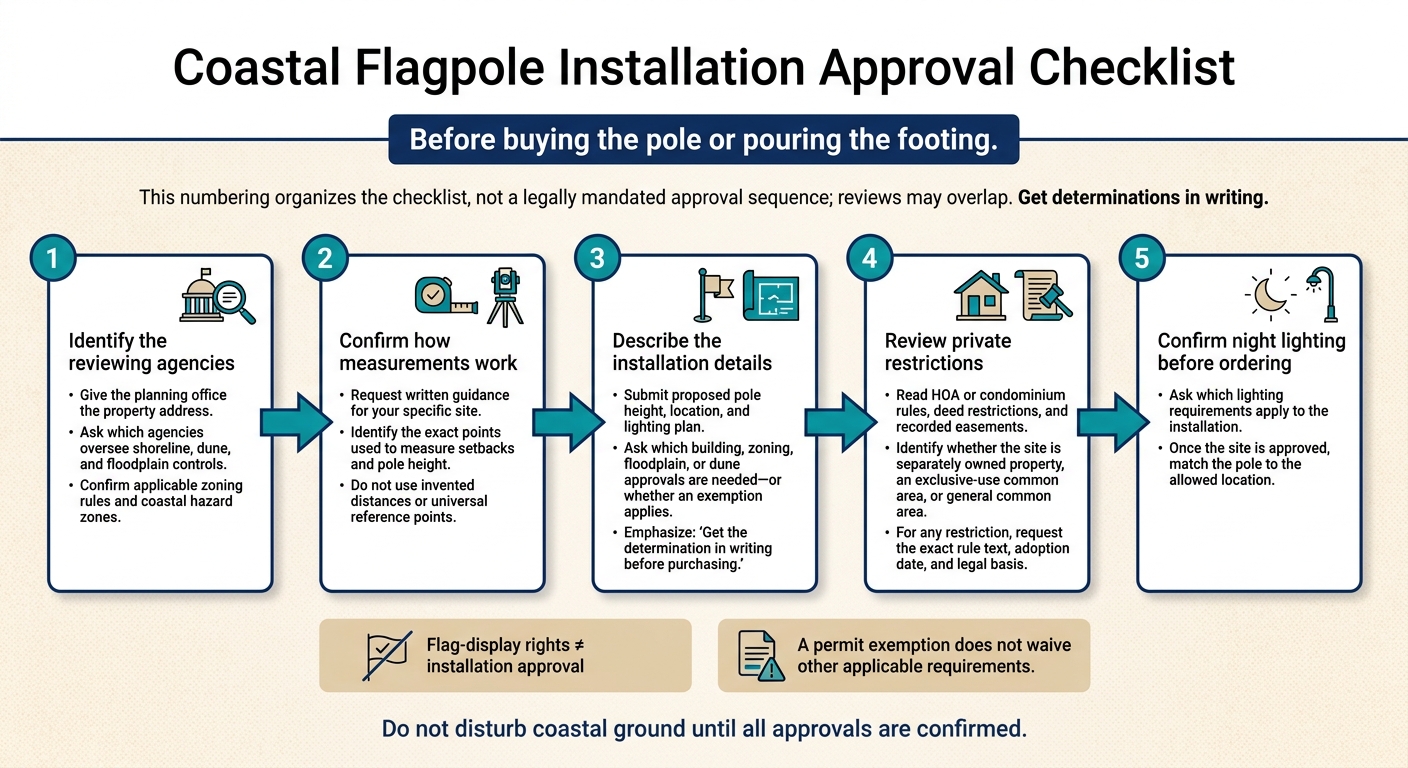
Coastal Flagpole Installation Approval Checklist
Use this checklist to check a coastal site before buying the pole or pouring the footing.
Identify the reviewing agencies. Give the planning office the property address. Ask which agencies oversee shoreline, dune, and floodplain controls, and which zoning rules and coastal hazard zones apply.
Confirm how measurements work. Request written guidance for your site that identifies the exact points used to measure setbacks and pole height.
Describe the installation details. In any of the five states above, submit your proposed pole height, location, and lighting plan. Ask which building, zoning, floodplain, or dune approvals you need - or whether an exemption applies. Get the determination in writing before purchasing.
Review private restrictions. Read the HOA or condominium rules, deed restrictions, and recorded easements. Check whether the installation would occupy separately owned property, an exclusive-use common area, or general common area. For any restriction, request the exact rule text, adoption date, and legal basis.
Confirm night lighting before ordering. Ask which lighting requirements apply to your installation. Once the site is approved, match the pole to the allowed location.
Choose a Flagpole After Checking Placement Rules
Once the site is approved, choose a flagpole that matches the approved site plan and rules. On an erosion-prone coastal lot, meeting the height limit isn’t enough. The pole also needs a foundation suited to unstable soil.
Check the flag size against the pole’s specifications. Local or HOA rules may limit flag size, pole type, and mounting location - not just height. Request equipment specifications so your building department or engineer can check them against the site requirements.
Action Flag sells flagpoles and accessories. Treat it as a product source, not a legal authority.
The owner remains responsible for compliance. A pole’s availability or wind rating doesn’t mean it has local approval. Have the local reviewing office - and an engineer, where required - approve the equipment and installation plan.
Conclusion: Confirm Local Rules Before Installation
Coastal flagpole rules in Florida, California, North Carolina, New Jersey, and Virginia depend on the jurisdiction, property type, and site designation. These five states show why you need to check local rules rather than assume where a pole can go.
Before ordering equipment, ask your town or county planning department which ordinance applies to your lot, what its coastal designation is, and which approvals you need. Also check recorded property restrictions.
On erosion-prone lots, site approval matters just as much as the pole itself. Do not disturb coastal ground until all approvals are confirmed. Check the local approval list before breaking ground.
FAQs
Can I appeal a flagpole placement denial?
You can often appeal a denial, but the process depends on the governing authority. If a homeowners association or local board denies your request, ask for the rule’s text, its adoption date, and the statutes cited to support it.
You can respond in writing and reference relevant protections, such as the federal Freedom to Display the American Flag Act or applicable state civil codes.
For a formal complaint or a specific violation, contact your city clerk or legal counsel.
Do I need new approval to replace a flagpole?
Approval requirements depend on your local jurisdiction and property type. Local building codes, zoning laws, and homeowners associations (HOAs) - not the U.S. Flag Code - typically set these rules. Some municipalities require permits for flagpoles 15 feet or taller.
Before replacing your flagpole, check with your local building department or a professional installer. Historic districts and managed residential communities may have extra restrictions.
What if my HOA and town rules conflict?
Local government regulations usually take priority over HOA rules for safety, zoning, and building permits. Your HOA may set rules for appearance or height, but you still need to follow municipal building codes and zoning laws. If those rules conflict, contact your city clerk or legal counsel to confirm which authority has jurisdiction over your property.

