


I choose flag trim by checking the display rules first - not just the color. For an indoor or carried flag, I confirm which trim is allowed. For a stationary outdoor pole, I skip fringe.
Here’s my checklist before ordering:
- Choose the trim: Fringe borders the flag’s three free edges; cords and tassels hang near the top of the staff.
- Check the material: I compare fiber, color, construction, and care instructions. Outdoor-rated flag fabric doesn’t mean outdoor-rated trim.
- Measure the fit: I record flag size, fringe depth, cord length, and tassel length in feet and inches, then check hardware and floor clearance.
- Plan for use and storage: I check attachments before each display, follow weather and cleaning limits, and store trim dry without crushing or tangling it.
Before buying, I confirm <u>what the price includes</u>: one tassel, a pair, or a full set, plus any sewing or hardware.
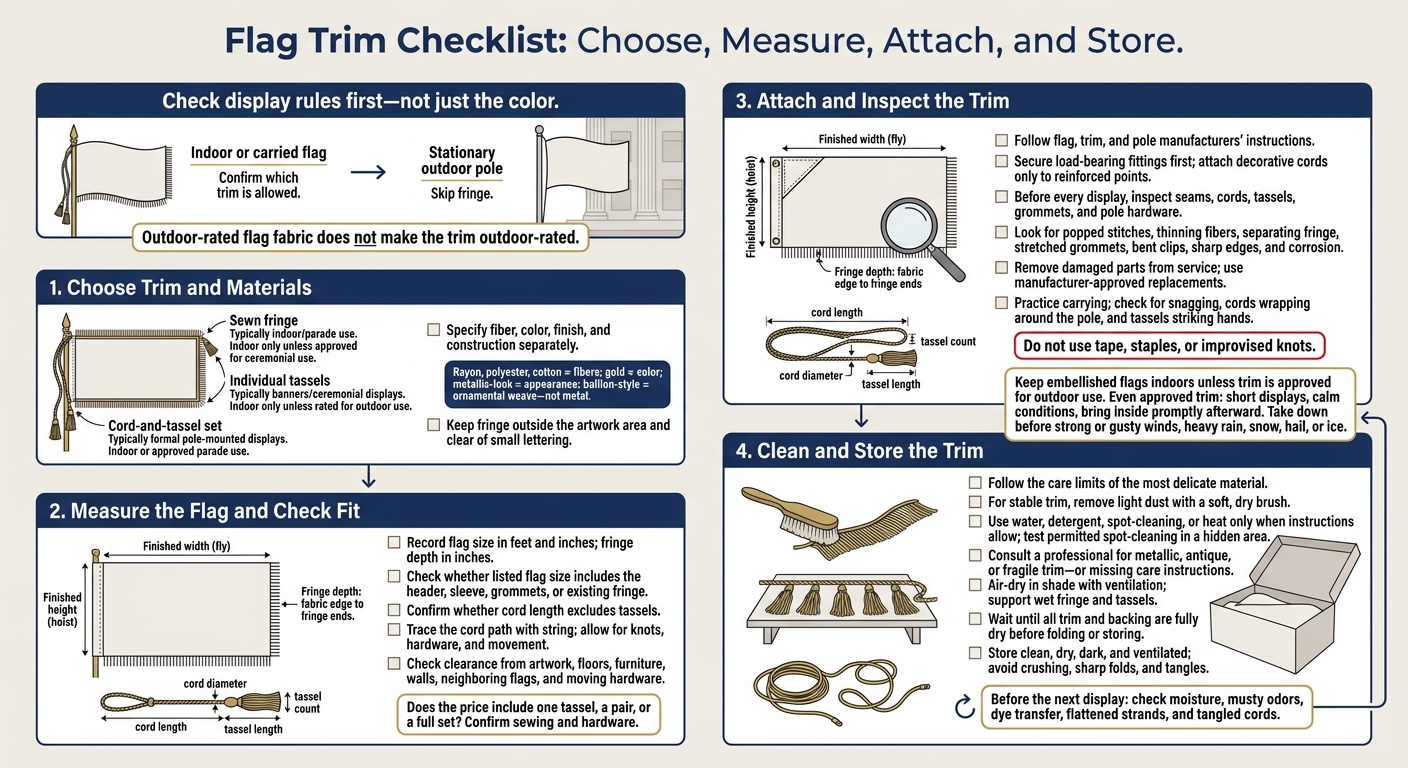
Flag Trim Checklist: Choose, Measure, Attach, and Store
Step 1: Choose Trim and Materials
For carried flags, choose trim that stays secure and resists snagging. For stationary indoor displays, focus on texture and detail. The design should stay readable whether the flag lies flat or hangs. Once you know where and how it will be used, compare trim styles and construction.
Compare Fringe, Tassels, and Cord-and-Tassel Sets
Choose trim with attachment points that suit the flag and its use.
| Trim type | Appearance | Typical use | Attachment location | Exposure suitability |
|---|---|---|---|---|
| Sewn fringe | Continuous decorative border | Indoor presentation flags and parades | Sewn along the three free edges, excluding the hoist edge | Indoor only unless approved for ceremonial use |
| Individual tassels | Separate hanging accents | Banners and ceremonial displays | Designated corners, hardware, or other attachment points | Indoor only unless rated for outdoor use |
| Cord-and-tassel set | Braided cord with matching hanging tassels | Formal pole-mounted displays | Draped around the pole below the finial | Indoor or approved parade use |
For custom artwork, ask for a proof showing the finished border and attachment points. Keep fringe outside the artwork area and clear of small lettering.
Once you've chosen the trim type, select a fiber and finish suited to how often the flag will be handled.
Choose Materials, Colors, and Finishes
Specify fiber, color, finish, and construction separately. Rayon, polyester, and cotton identify the fiber; gold identifies the color, not the material. Metallic-look describes appearance, while bullion-style refers to an ornamental weave - not metal. Along with the material, check braid tightness, fringe density, and tassel fullness.
| Material or style | Visual effect | Durability | Maintenance | Suitable settings |
|---|---|---|---|---|
| Rayon | Smooth and lustrous | Best for indoor ceremonial displays; don't assume outdoor resistance | Follow the specified cleaning method | Formal indoor displays |
| Polyester | Varies by yarn and finish | Useful for repeated handling; exposure ratings vary | Check care and colorfastness guidance | Frequently handled displays; outdoor use only if rated |
| Cotton | Soft, natural texture | Needs care in damp conditions | Check moisture and drying instructions | Protected indoor displays |
| Metallic-look or bullion-style | Ornate, reflective, or textured | Depends on the underlying fiber and construction | Follow finish-specific care instructions | Formal indoor settings unless otherwise rated |
Use a physical sample or manufacturer swatch to match approved institutional colors. When comparing quotes, look beyond color: check fringe density, braid complexity, tassel size, color match, and sewing labor.
For outdoor use, verify the trim's UV, moisture, and weather resistance. Outdoor-rated flag fabric does not make the trim outdoor-rated.
Next, confirm measurements and attachment points before ordering.
sbb-itb-4fbc981
Step 2: Measure the Flag and Check Fit
Measure Fringe, Cords, and Tassels
Once you’ve selected the trim type, lay the flag flat. Record its finished height (hoist) and width (fly) in feet and inches. Check whether the listed size includes the header, sleeve, grommets, or existing fringe. If trim could cover lettering or emblems, record the visible fabric area, too. The trim must fit both the display size and the attachment method.
Measure each edge that will receive fringe. Then measure the fringe depth in inches, from the fabric edge to the fringe ends. Include that depth when checking the finished flag’s clearance from walls, cases, furniture, floors, and neighboring flags.
For cord-and-tassel sets, record the cord length and diameter, tassel count, and tassel length. Confirm whether the listed cord length excludes the tassels.
Use string to trace the cord’s path through the eyelet, sleeve, or header. Leave room for knots, hardware, and movement. Check that the tassels clear lettering, emblems, the floor, and moving hardware. Parade and ceremonial displays need extra room for handling and swing. Use these measurements to confirm hardware fit before ordering.
Confirm Attachments and Order Details
Next, check how the trim will attach. Inspect the header, sleeve, grommets, tabs, ties, rings, or eyelets. Confirm that the pole hardware works with the cord or tassel attachment method. Take photos of the setup and record key dimensions for the supplier.
Group the remaining specifications into three categories:
- Size: Send the supplier the finished size, artwork placement, trim dimensions, colors, materials, stitching, hardware, quantity, and delivery date. For sewn fringe, confirm which edges get trim and whether it changes the finished dimensions.
- Attachment hardware: Confirm the number of cord-and-tassel sets, attachment loops, mounting hardware, and installation instructions.
- Order terms: Check whether the quote covers the finished flag, a loose trim kit, or installation. Get written confirmation of unit prices in U.S. dollars, minimum quantities, production and shipping times, and whether sewing is included.
Verify American-made claims or certifications for each accessory, not just the flag. For repeated displays, assemble one sample and approve its proportions before placing a bulk order.
Step 3: Attach and Inspect the Trim
Follow the flag, trim, and pole manufacturers’ installation instructions, using the fit and attachment points confirmed in Step 2. For flags handled often, use reinforced stitching and hardware. Secure the flag’s load-bearing fittings first, then attach decorative cords only to reinforced points.
Check the assembled flag before every display.
Inspect Stitching, Cords, and Hardware
Before each event, check seams, cords, tassels, grommets, and pole hardware. Look for popped stitches, thinning fibers, separating fringe, stretched grommets, bent clips, sharp edges, and corrosion. Remove damaged parts from service and replace them with manufacturer-approved parts. Do not use tape, staples, or improvised knots.
After assembly, make sure every connection is fully seated without tugging on the fabric. Practice carrying the flag before public use. Check whether tassels strike the bearer’s hands, cords wrap around the pole, or fringe catches on doors and railings. Fix anything that interferes with carrying the flag, and inspect the setup again after the event. Outdoor use calls for stricter weather limits.
Limit Outdoor Use
Keep embellished flags indoors unless the trim is approved for outdoor use. Even with approved trim, keep outdoor displays short, use the flag only in calm conditions, and bring it inside promptly afterward.
Take the flag down before strong or gusty winds, heavy rain, snow, hail, or ice. Wet or frozen trim adds weight and puts strain on seams and attachments. For American flags, do not display the flag in inclement weather unless it is made of all-weather material.
Step 4: Clean and Store the Trim
After use, follow the care limits of the most delicate material. Before washing, spot-cleaning, or applying heat, check the instructions for the flag fabric, fringe, cords, tassels, and metallic finishes. A washable flag body doesn’t mean the trim is washable, too.
Follow Cleaning Instructions
To remove light dust from stable trim, use a soft, dry brush without pulling the strands. Use water or detergent only if the material’s care instructions allow it. If spot-cleaning is permitted, test a hidden area first, then dab rather than rub. Stop if color transfers, fibers shed, or the finish changes.
For metallic, antique, or fragile trim - or when care instructions are missing - consult a textile or flag-cleaning professional before cleaning.
Air-dry the flag in a clean, shaded, well-ventilated area. Support wet fringe and tassels so their weight doesn’t stretch the stitching, and keep fringe away from other fabrics to limit dye transfer. Wait until all trim and backing are fully dry before folding or storing. Avoid dryer heat, steam, and ironing unless expressly approved.
Store Trim Without Crushing or Tangling
Once everything is dry, store the flag in a clean, dry, dark, ventilated indoor space - not a damp basement or hot attic. Lay it flat when practical, placing acid-free tissue between layers. Avoid sharp folds through fringe or tassels.
Use a breathable bag or archival box with enough room to keep the trim from getting crushed or tangled. Never stack heavy objects on top.
If permitted, detach removable cords, coil them loosely, and secure them with soft fabric ties. Lightly wrap tassels in acid-free tissue, keeping them away from hooks and other hardware that could snag them.
Before the next display, check for moisture, musty odors, dye transfer, flattened strands, and tangled cords. Gently reshape the trim by hand, without pulling or applying heat.
Conclusion: Check Requirements Before Ordering
Once you’ve compared trim styles, materials, and fit, check the display rules before ordering. Gold fringe is optional on indoor ceremonial and parade flags and is usually left off flags on stationary outdoor poles. Match the material and color to the approved display. Secure the trim without covering the design or changing how the flag hangs.
Before ordering from Action Flag, confirm hardware fit and whether the listed price covers one tassel, a pair, or a full set. Check shipping, delivery timing, return terms, and care instructions, and mention any event deadline.
FAQs
Does gold fringe change an American flag’s meaning?
No, gold fringe does not change an American flag’s meaning. It’s a decorative finishing touch that gives the flag a polished, formal look for ceremonies. It’s commonly used for indoor displays, parades, and official events.
What fringe depth looks best on my flag?
Fringe depth varies by offering, so choose fringe that fits your flag’s size and style. Action Flag’s pre-finished indoor and parade flags come with professional-grade fringe for a polished, ceremonial look.
Look for a high-quality nylon or cotton flag with fringe included in its formal finish. Make sure the finished flag suits your indoor display or ceremonial setting.
Can I add fringe to an existing flag?
Adding fringe to an existing flag without a pole hem or sleeve isn’t standard practice. Fringe is meant for indoor and ceremonial displays. Manufacturers typically add it during production, along with a pole sleeve for mounting.
For a polished, ceremonial look, Action Flag offers flags with gold fringe and pole sleeves for indoor displays and parade use.

