


Red on a flag can mean courage, conflict, or both. I look at the flag’s history, symbols, and setting before assigning a meaning - not the color alone.
The U.S. flag shows why dates matter: it was adopted in 1777, but the link between red and hardiness and valor comes from the 1782 Great Seal explanation.
Here’s how I approach the main uses:
- National flags: Check each country’s history, from revolution in China to Ottoman roots in Turkey and national identity in Albania.
- Battle and protest flags: Separate messages of defiance and struggle from later tributes to sacrifice.
- Warning flags: Check local beach guidance or racing rules.
- Custom flags: Define your message, check for unintended links, and add a short caption.
My rule: <u>check the record before choosing the meaning</u>.
How Red Connects Courage and Conflict
Red gets its force from two associations: blood, for sacrifice, and fire, for danger and revolt. These links appear in four common readings.
Courage, Valor, Sacrifice, and Martyrdom
| Meaning | Flag context | Documented historical use |
|---|---|---|
| Courage - facing danger | Honors the risks defenders take. | U.S. flag commentary links red with courage. |
| Valor - bravery in action | Recognizes brave acts in combat or service. | Historical flag commentary connects red with national defense. |
| Sacrifice - a cost borne for others | Recalls blood shed defending a country. | Modern flag commentary honors defenders’ losses. |
| Martyrdom - death for a belief or cause | Remembers people killed in political struggle. | Remembrance of the Paris Commune’s dead linked red with socialist martyrdom. |
War and revolution show how these meanings took shape.
Red Flags in Battle and Revolution
Plain red flags have signaled defiance since at least the 14th century. In some military settings, red also meant no surrender would be accepted. But that meaning wasn't shared by every army or used in every period.
During the French Revolution, the National Assembly prescribed red in 1789 to signal that martial law was in effect and crowds should disperse. On July 17, 1791, Mayor Jean-Sylvain Bailly raised a red flag at the Champ de Mars, where National Guard troops under Lafayette fired on a republican crowd; the episode helped turn an official warning into a revolutionary symbol. From March to May 1871, the Paris Commune used the red banner as its council challenged the French government and its militia defended the city. Its violent suppression linked red with martyrdom and socialism; later communist and labor movements adopted it for struggle and solidarity.
Today’s warning flags carry that same sense of urgency: red signals immediate risk.
Red Flags as Modern Warnings
At beaches, red flags usually warn of dangerous surf or currents, though local systems vary.
In motorsports, red flags stop or suspend a session under the governing rules.
sbb-itb-4fbc981
What Red Means in National Flags
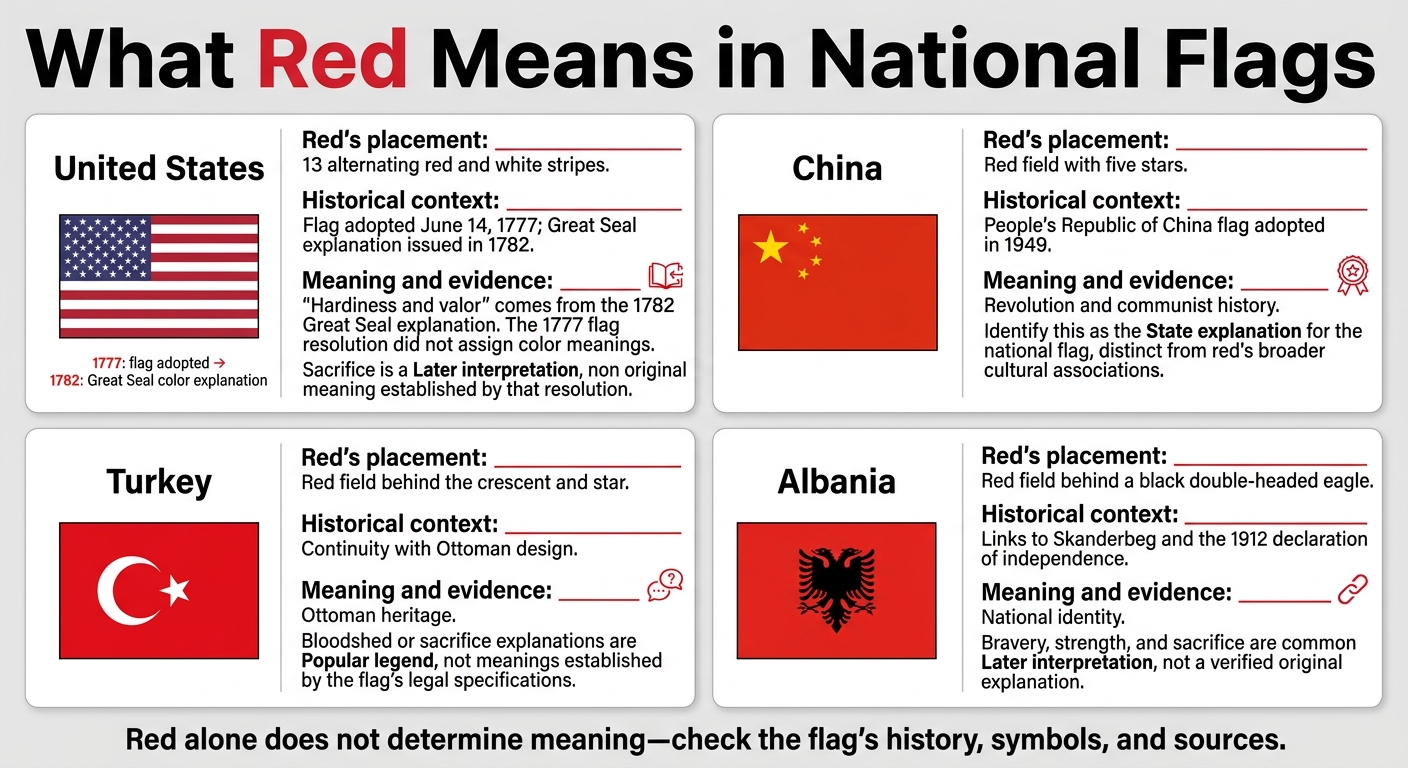
What Red Means in National Flags
On national flags, red often moves beyond battlefield symbolism to represent the state itself. Its meaning depends on each country’s history.
| Country | Red’s placement | Historical context | Attributed meaning |
|---|---|---|---|
| United States | 13 alternating red and white stripes | Flag adopted June 14, 1777; Great Seal explanation issued in 1782 | Hardiness and valor, later read as sacrifice |
| China | Red field with five stars | People’s Republic of China flag adopted in 1949 | Revolution and communist history |
| Turkey | Red field behind the crescent and star | Continuity with Ottoman design | Ottoman heritage; popular legends of bloodshed or sacrifice |
| Albania | Red field behind a black double-headed eagle | Links to Skanderbeg and the 1912 declaration of independence | National identity; commonly, bravery, strength, and sacrifice |
United States: Hardiness and Valor
Red signifies hardiness and valor through the 1782 Great Seal explanation; the 1777 flag resolution did not assign color meanings. Sacrifice is a later commemorative reading, not an original meaning established by that resolution.
China: Red and Revolution
On China’s flag, red points to revolution and reflects the state’s communist origins. This state explanation belongs to the national flag adopted in 1949, rather than red’s broader cultural associations.
Turkey: Ottoman Roots and Later Meanings
Red reflects Ottoman heritage through Turkey’s continuation of Ottoman flag design. Blood-and-sacrifice explanations remain popular legends rather than meanings established by the flag’s legal specifications.
Albania: Red and the Double-Headed Eagle
Red expresses national identity alongside the black double-headed eagle, with historical links to Skanderbeg and the 1912 declaration of independence. Bravery, strength, and sacrifice are common interpretations, not a verified original explanation.
How to Interpret and Choose a Red Flag
Use the historical examples above as a checklist when reading or designing any red flag.
Check the Design, Date, and Sources
Before using a flag, confirm its owner, date, and documented meaning with authoritative sources. Separate its original intent from later interpretations.
Read Red Alongside Symbols and Colors
Red alone doesn’t determine a flag’s meaning. Its placement, emblems, inscriptions, and surrounding colors shape how people read it - and can matter more than the red itself.
Japan’s Hinomaru places a red sun on white. The design is much older than its formal adoption in 1999, so that date should not be presented as its origin. Here, the central symbol directs the reading toward the sun and national identity - not automatically toward conflict.
Write a Custom Flag Design Brief
For a business, school, or veterans’ group, start with the message. Then define the audience, historical references, and display setting. Compare the full design with political and military flags: a borrowed pattern may suggest more than courage. Ask a representative from the relevant community to review any uncertain references.
Record the intended meaning, setting, and construction details in the brief. State whether the flag should be printed or appliquéd, and include a caption explaining each symbol. This gives viewers context for reading red as courage, conflict, or both, rather than leaving them to guess.
Conclusion: History Shapes Red’s Meaning
These examples show that red can stand for valor, sacrifice, defiance, revolution, or warning. Courage and conflict can coexist: a flag can honor bravery while recalling the struggle behind it.
When using or describing a red flag, check historical claims against museum records or archival sources. For ceremonial or custom designs, include a short program note or caption explaining what red means in that setting.
FAQs
How can I verify a flag’s original symbolism?
Check historical records, studies of local customs and beliefs, and official interpretations, since a flag’s meaning can vary by country and context. Modern associations can overshadow a historical flag’s original meaning, so cross-check what you find with local sources or reliable scholarly work.
Digital tools can use established databases to explain common color and symbol meanings. But check their results against documents about the flag’s history.
Does a red flag’s meaning change by audience?
Yes. A red flag’s meaning depends on who sees it and the context. In the West, red often stands for courage, valor, or sacrifice. In China, it can symbolize good fortune.
In socialist or communist settings, red can represent revolutionary ideals and the working class. In other societies, it may stand for the blood of ancestors. History and personal experience also shape these meanings, which can change over time.
How can my custom red flag convey courage without conflict?
Balance red’s intensity with other colors. White can emphasize purity and optimism, while blue can suggest justice, stability, and community trust. Choose simple symbols tied to your mission instead of aggressive imagery to convey courage and a constructive purpose.
Action Flag offers custom flag creation services to help you design a clear, professional banner that reflects these values and your mission.
