


I’d choose a memorial flag case by fit first, then materials. Measure your folded flag’s width, height, and thickness - even a case labeled for a 5 × 9½-foot burial flag may not fit your fold.
Here’s what I’d check for each part:
- Solid hardwood: A sturdy frame with visible grain; needs sound joints and stable indoor humidity.
- Glass: A clear, scratch-resistant front panel, but heavier and more likely to break on impact.
- Acrylic: About 50% lighter than glass at the same thickness and more impact-resistant, but easier to scratch.
- Metal: Strong frames and hardware; check for corrosion and a mounting weight rating.
- Backing materials: Flat support for the flag; choose a chemically stable surface rather than raw wood or ordinary cardboard.
Quick Comparison
| Material | Main role | Main strength | Main caution |
|---|---|---|---|
| Solid hardwood | Frame | Strength and wood grain | Humidity can cause movement |
| Glass | Front panel | Scratch resistance | Weight and breakage |
| Acrylic | Front panel | Lower weight and impact resistance | Surface scratches |
| Metal | Frame and hardware | Secure support | Corrosion varies by metal and finish |
| Backing materials | Interior support | Holds the folded flag flat | Some boards release harmful compounds |
My final checks: secure closures, mounting hardware rated for the finished case, and enough room to avoid pressing the flag against the panel. <u>Ask for documented UV-filtering data</u>, and keep the case out of direct sunlight - UV filtering reduces fading; it doesn’t stop it.
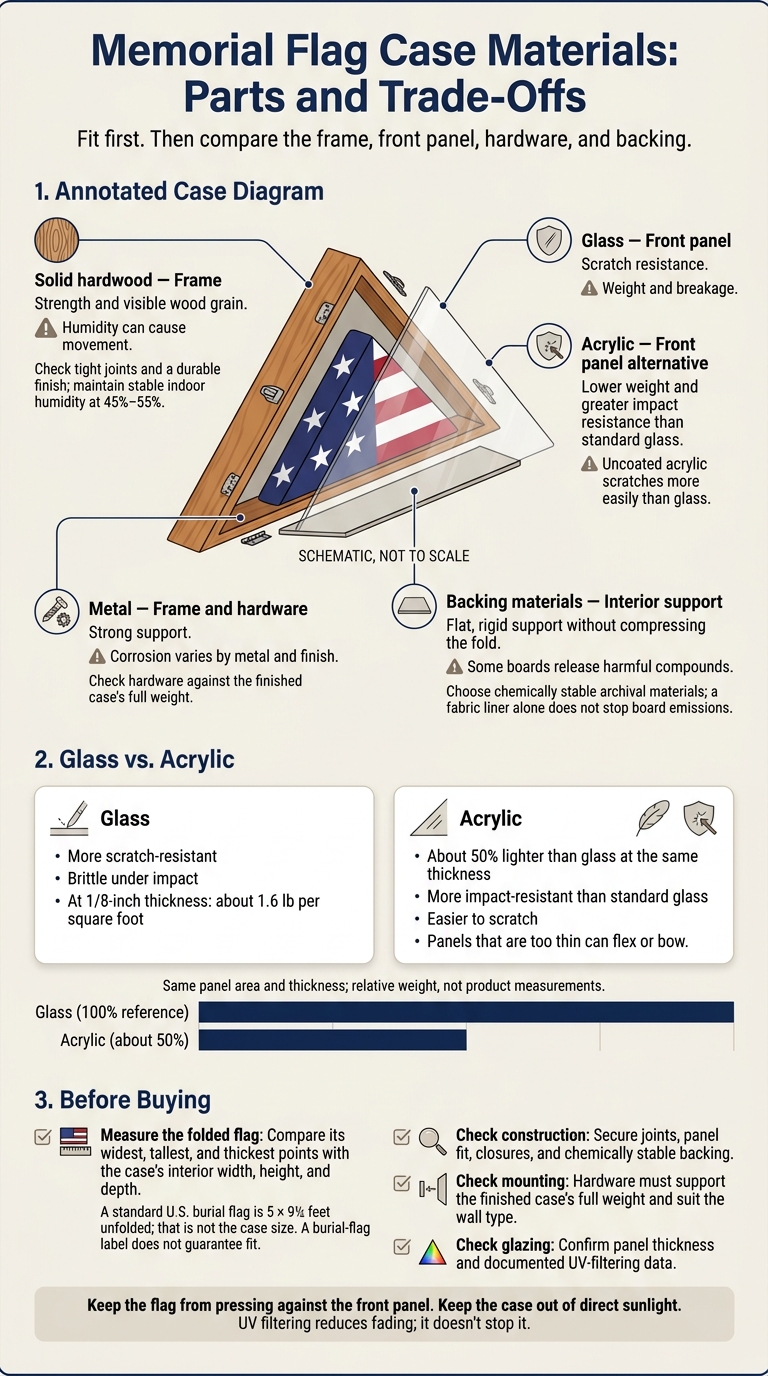
Memorial Flag Case Materials: Parts and Trade-Offs
Flag Case Parts and Proper Fit
Before comparing materials, check the case’s joints, panel fit, and closures. The front panel should sit securely in its frame, and the backing should close evenly without pinching the flag. Tight seams and secure latches, screws, or turn buttons help keep dust out and prevent accidental opening. Dust-resistant does not mean airtight.
Measure the folded flag, not the case. A standard U.S. burial flag measures 5 feet by 9½ feet unfolded, according to Arlington National Cemetery. Compare the folded triangle’s widest, tallest, and thickest points with the case’s interior width, height, and depth. A “burial flag case” label doesn’t guarantee a fit. Fabric thickness and how the flag is folded also affect the space it needs.
The flag should rest flat, without bunching or pressing against the front panel. Choose a smooth, colorfast, nonabrasive backing. Acid-free board or fabric-covered support is better than rough cardboard or unfinished wood. Keep adhesives, pins, and medal hardware off the flag.
For wall display, match the mounting hardware to the case’s full weight and wall type. Fasten it to a stud or use an appropriate anchor. For tabletop display, use a broad, stable base. Make sure you can reach the closures to inspect the interior without disturbing the folded flag.
Place the case away from direct sunlight, vents, fireplaces, and damp areas. UV-filtering glazing helps, but it does not prevent fading.
sbb-itb-4fbc981
1. Solid Hardwood
Solid hardwood is the most common choice for the frame, offering durability for long-term display.
Durability and Protection
Kiln-dried hardwood, tight joints, and a durable finish help the case last.
Appearance and Finish
Oak, cherry, walnut, and mahogany are common options, each with its own grain and color.
Clear finishes show the wood’s natural color, while stains change it. Satin offers a low-key look; gloss gives a more polished appearance. Choose a finish that suits a formal display without drawing attention away from the flag.
Weight and Structural Role
The frame supports the glazing, so wood type isn’t the only detail to check. Look for a recessed ledge, secure retaining strips or clips, and the finished hanging weight.
Care and Preservation Considerations
Dust the wood with a soft, dry microfiber cloth. Avoid abrasive cleaners and silicone-heavy polishes, and use polish only if the manufacturer recommends it. Keep indoor humidity stable at 45%–55% to help prevent swelling, cracking, and loose joints.
For a solid hardwood frame, the glazing should fit cleanly, and the finish should stay understated.
2. Glass Front Panels
Appearance and Finish
The frame gives the case its structure; the front panel puts the flag on display. Clear glass provides an unobstructed view of the folded flag. Beveled glass adds polished, angled edges for a more formal, decorative look. For etched or engraved names, dates, or military emblems, request a proof to check that the design won’t block the flag.
Durability and Protection
Glass resists surface scratches and helps keep dust and fingerprints off the flag without blocking the view. Still, grit and abrasive cleaning tools can scratch it. Glass is also brittle: drops, impacts, or pressure on unsupported edges can cause cracks or breakage.
Double-strength and 1/8-inch are not the same rating. Double-strength refers to a glass grade, not one exact thickness. Confirm the panel’s actual thickness and whether it’s annealed, tempered, or laminated. The label alone doesn’t tell you which safety treatment, if any, it has.
Weight and Structural Role
At 1/8-inch thickness, glass weighs about 1.6 lb per square foot, adding to the load on the frame and wall mounting. Check the total hanging weight, and inspect the panel for chips or looseness before inserting the flag. The extra weight calls for secure framing and mounting.
Care and Preservation Considerations
Use a soft microfiber cloth and a manufacturer-approved, nonabrasive glass cleaner. Spray the cloth, not the glass. Ordinary clear glass does not block UV by default, so ask for documented UV filtering and keep the display out of prolonged direct sunlight.
Next, the frame and hardware must support the panel.
3. Acrylic Front Panels
Weight and Structural Role
Acrylic weighs about half as much as glass of a similar size, cutting weight without sacrificing visibility. That reduces the load on wall-mounted or larger displays. Match panel thickness to the case size and mounting method - a panel that’s too thin can flex or bow.
Durability and Protection
Acrylic handles impact better than standard glass, making it a useful choice for cases moved often or mounted higher. But it isn’t unbreakable, and uncoated acrylic scratches more easily than glass. For displays handled often, consider an abrasion-resistant coating.
Appearance and Finish
Clear acrylic offers an unobstructed view of the folded flag, but finish options vary by product. Check a sample or specification sheet for haze, reflections, tint, and distortion. Keeping the panel scratch-free helps preserve that clarity.
Care and Preservation Considerations
Ask for documented UV-blocking data, rather than relying on marketing labels.
For example, verify that any advertised UV-blocking percentage applies to the panel you’re buying.
Clean acrylic with a soft, damp cloth, mild soap, and lukewarm water. Avoid paper towels, ammonia, alcohol, acetone, and other solvents. Support the panel as you clean so it doesn’t flex against the flag or frame.
4. Metal Frames and Hardware
After the front panel, the metal parts help determine how securely the case holds together.
Weight and Structural Role
Check which parts are metal. The frame, hinges, closures, brackets, or plaque may be metal even if the main body is wood. Make sure the wall hardware is rated to support the case’s total weight.
Durability and Protection
Aluminum resists corrosion, but it can still pit in damp or coastal conditions. Stainless steel works well for hinges, screws, and latches. Coated steel relies on an intact finish to resist rust.
Appearance and Finish
Brushed finishes help hide light handling marks. Polished metal shows fingerprints and scratches more readily. A metallic finish doesn’t mean the part is metal.
Care and Preservation Considerations
Avoid abrasive pads or metal polish that could damage coatings. Periodically check hinges, closures, and wall brackets for loose parts or corrosion. Keep sharp edges and screw heads away from the flag.
Once the frame and hardware are secure, the backing keeps the folded flag in place.
5. Backing Materials
Weight and Structural Role
The backing gives the folded flag flat, rigid support and helps anchor the interior display. It should fit snugly without compressing the fold. Larger cases may need a reinforced panel or extra structural support.
Your choice also affects the case’s weight, durability, and the flag’s long-term preservation.
| Backing option | Rigidity and mounting | Preservation considerations |
|---|---|---|
| Hardboard | Rigid for smaller panels; holds fasteners, but edges may crumble | Avoid direct textile contact; may emit harmful compounds. |
| Solid wood | Strong but heavy; shifts with humidity; holds screws well | Keep the textile separate from raw wood and uncured finishes. |
| Plywood | Rigid and stable; holds screws well | Keep the flag separate from wood and adhesive emissions. |
| Acid-free, lignin-free board or honeycomb panel | Rigidity varies; may need extra structural support | Choose chemically stable materials made for archival display. |
Appearance and Finish
A neutral fabric cover keeps attention on the flag, while dark fabric adds contrast. Keep the surface smooth and wrinkle-free. Use felt or velvet only as a barrier - not in direct contact with the flag.
Care and Preservation Considerations
Let wood finishes fully cure before assembly. The flag should rest against a conservation-appropriate barrier, such as washed, undyed fabric over a suitable support. A fabric liner alone does not stop board emissions.
Check removable backs for bowing, yellowing, odor, or changes in fit. If the flag is fragile or has historical importance, consult a textile conservator before sewing it to a support or applying permanent treatments.
Flag Case Materials Compared
With the material breakdown covered, here’s how the parts compare by function, durability, weight, appearance, and fit.
| Material category | Common use | Durability | Appearance | Weight | Main drawback |
|---|---|---|---|---|---|
| Solid hardwood | Frame or housing | Rigid; durability depends on joinery and finish | Warm, visible grain | Moderate to heavy | Sensitive to humidity changes |
| Glass | Front panel | Resists scratches but is vulnerable to impact | Clear, formal | Heavier than comparable acrylic | Can break |
| Acrylic | Front panel | Resists impact; standard grades scratch easily | Clear; appearance varies with thickness and finish | Lighter than comparable glass | Surface scratching |
| Metal | Frame, hardware, or trim | Strong; corrosion resistance depends on the finish | Modern or ceremonial | Varies by alloy and design | May corrode |
| Backing materials | Backing/support panel | Durability depends on material, thickness, and fastening | Usually hidden; lining affects appearance | Varies widely | Some boards can off-gas harmful compounds |
For most buyers, the front panel is the main choice. Glass offers scratch resistance and a formal look. Acrylic weighs less and handles impacts better. Check the panel’s UV rating, too.
If you’re mounting the case on a wall, choose hardware rated to support the weight of the finished assembly.
What to Check Before Buying
Compare these details before choosing a flag case.
- Fit: Measure your folded flag, then check the case’s interior dimensions. Confirm whether it fits a 5 x 9.5-foot burial flag or a 3 x 5-foot presentation flag.
- Front panel: Check the material, thickness, and documented UV rating.
- Frame and backing: Look closely at photos for gaps, uneven corners, or loose trim. Find out what backing sits beneath the lining - don’t assume it’s archival or chemically inert.
- Closures and mounting: Verify the closure type, included hardware, hanging orientation, and weight rating.
- Product details: Check the specific Action Flag listing for exact fit, glazing, backing, closure, and mounting details.
Conclusion: Choose Materials for Your Display
The right choice depends on how the materials work together. No single material suits every display. Choose solid hardwood for a classic look, glass for clarity and scratch resistance, acrylic for less weight and better impact resistance, metal for strong frames and hardware, and a stable backing for shape and support.
Material quality matters, but fit and construction matter more. The best protection comes from solid construction, inert interior materials, and enough space to keep the folded flag from touching the front panel.
Keep the case indoors, away from direct sunlight and heat vents. UV-filtering glazing helps reduce fading, but it won't prevent it entirely.
FAQs
Which wood best suits a family heirloom flag case?
Solid hardwoods - oak, walnut, cherry, mahogany, and maple - are the best choice for a family heirloom flag case. They offer durability, strength, and a timeless look. Pine costs less, but it’s softer and less durable, so it isn’t recommended for permanent heirloom memorials.
Action Flag offers handcrafted solid hardwood cases, often paired with UV-protective glass to help shield your flag from damage caused by its surroundings.
Can I upgrade my case with UV-filtering glazing?
Yes. UV-protective glazing is recommended to help preserve your flag over time. UV rays can fade its colors and weaken fabric fibers.
Action Flag offers memorial flag cases with UV-filtering glass or acrylic that can block up to 99% of harmful rays. This helps protect your flag from light damage and keeps its colors bright.
How can I tell if my case’s backing is archival?
Check the product description to confirm that the backing is acid-free. This helps protect your flag’s fabric from damage caused by its surroundings and harmful chemical reactions over time.
Action Flag offers a variety of memorial flag cases. Choose one with archival-quality backing to help preserve your display as a cherished keepsake for generations.

